
This is Article 4 in an ongoing series examining America's abandoned and orphaned well problem.
The first three articles established three facts that tend to get discussed separately but rarely examined together. Wells that were formally plugged and abandoned have later shown pressure and fluid migration. Regulatory and legal classifications struggle to map cleanly onto physical well behavior. And the number of legacy wells subject to those conditions is large enough that even low failure probabilities matter.
This article doesn't argue that historical operators failed to follow regulations, nor that every plugged well is unsafe. It addresses a narrower and more technical question: why failure decades after plugging isn't anomalous but structurally predictable, given how abandonment was engineered. The focus here is mechanics rather than blame. Material degradation, evolving pressure regimes, and the absence of any defined post-closure lifecycle.
The mistaken assumption behind permanent abandonment
Most abandoned oil and gas wells that fail decades later weren't poorly plugged. They failed because plugging was treated as a permanent event rather than as a long-duration engineering system.
As documented in Article 1: When Dead Wells Come Back to Life, many high-profile failures involved wells that were plugged according to the standards of their time and formally closed in regulatory records, yet later exhibited pressure, leakage, or uncontrolled flow.
This article examines cement degradation, casing corrosion, pressure migration, and well integrity over time, drawing on documented failure investigations, re-entry inspections, and peer-reviewed research on long-term subsurface behavior.
In most cases, operators followed the regulations in force at the time. Cement volumes were placed. Surface equipment was removed. Paperwork was filed. The well exited active oversight. What failed wasn't compliance. It was the assumption embedded in the system, that plugging is a permanent event rather than the start of a long-duration engineering condition.
Plugging was designed as a closure event, not a lifecycle system
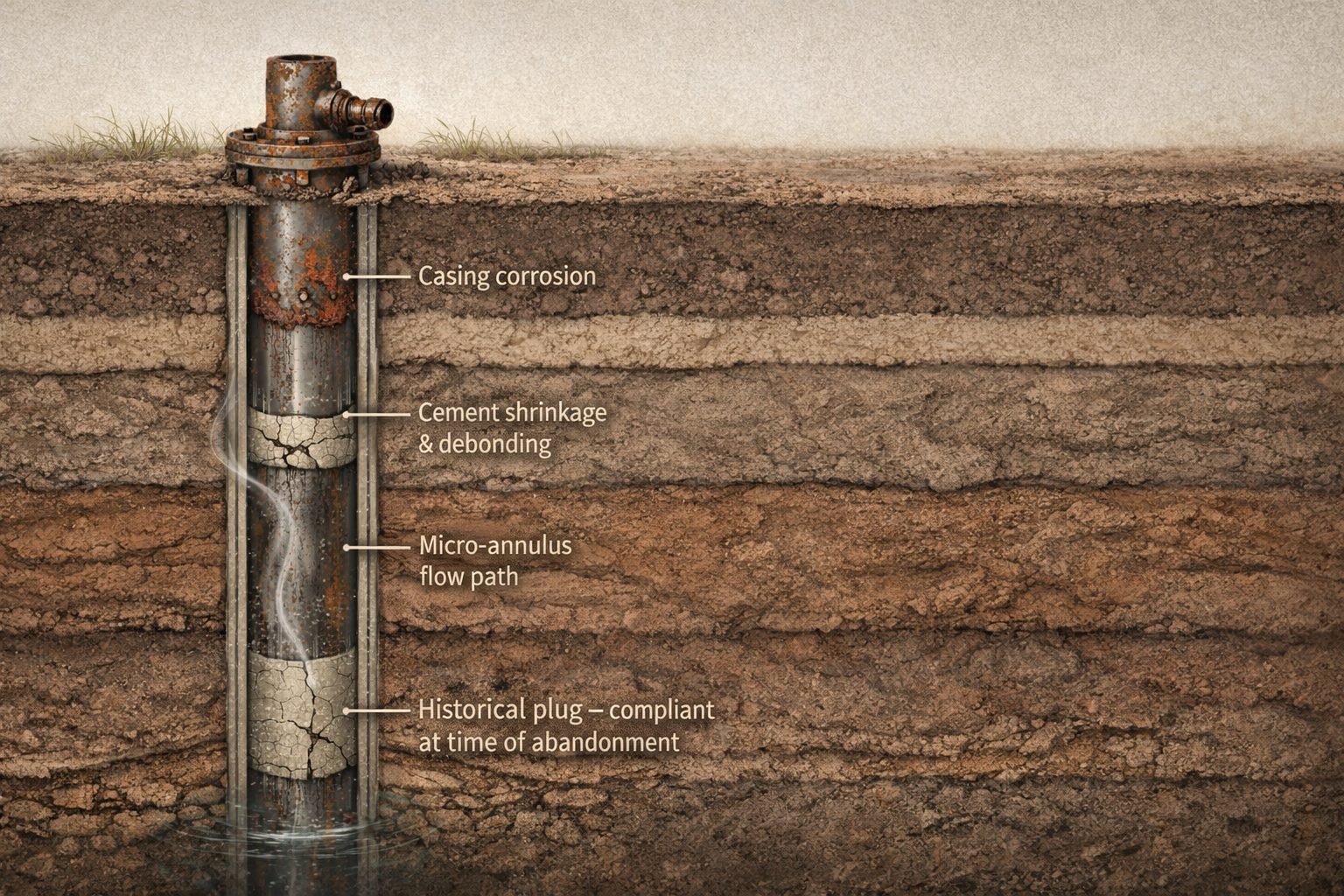
Historically, plugging regulations focused on actions rather than performance over time. Rules specified where cement plugs should be placed, minimum plug lengths, and surface restoration requirements. They didn't specify a design service life, long-term chemical durability, performance under evolving pressure regimes, or any monitoring or verification decades later.
A plugged well was treated as complete once the last form was filed. No mechanism existed to revisit its integrity unless a surface failure forced attention. This framing helps explain why wells that remain mechanically intact for decades still fall outside any active management category, a definitional gap explored in Article 2: The Terminology That Shapes Liability.
How cement degrades over time
Oilfield cement was never designed to stay inert forever. Even under ideal placement conditions, it undergoes volumetric shrinkage during curing, thermal contraction and expansion, chemical interaction with formation fluids, and stress redistribution as surrounding materials deform.
Shrinkage alone can create a microannulus, a thin and continuous pathway between cement and casing or formation. That pathway may transmit little or nothing for decades. It only needs to exist for pressure to eventually use it.
How steel casing corrodes after abandonment
Casing corrosion isn't hypothetical. Legacy wells were commonly exposed to high-salinity formation water, dissolved gases, microbial activity, and electrochemical gradients. Even modest corrosion rates become material over decades, and localized pitting, particularly at threaded connections, accelerates the loss of structural margin.
How subsurface conditions change after drilling
Subsurface conditions evolve. Reservoir depletion, disposal and injection, aquifer drawdown and rebound, and basin-scale compaction all alter pressure and stress fields long after a well is abandoned. Pressure changes don't create failure mechanisms so much as reveal the ones already present.
Viewed at scale, as outlined in Article 3: The Scale of America's Abandoned Well Problem, this behavior isn't surprising. It's the expected outcome of applying time-dependent degradation to a very large population of aging wells.
Why failure is delayed and therefore underestimated
Failure is delayed because degradation is gradual, pressure regimes evolve slowly, and there's no routine monitoring to detect early-stage leakage. The absence of observed failure tells you more about the absence of inspection than about the integrity of the well.
Why this isn't an argument about blame
This analysis doesn't require a finding of negligence. It identifies a system that treated abandonment as an endpoint rather than as a reliability problem with a long tail.
Why modern practices reduce risk but don't eliminate it
Modern plugging standards improve near-term performance, but they still lack defined post-closure lifecycles, probabilistic failure modeling, and long-term monitoring requirements. Abandonment still assumes permanence in a setting where real uncertainty remains.
The real engineering question we avoided asking
For decades, the implicit question was whether the well was properly plugged today. The reliability question that went unasked was the harder one: what is the time-dependent probability of isolation failure, and how is that risk managed over the service life of the system?
Where this leaves us
From a reliability-engineering perspective, plugged wells are unmanaged, long-duration systems operating without inspection, redundancy, or defined failure thresholds. When failure eventually occurs, it's discovered reactively, often after environmental or operational impact, rather than predicted or mitigated.
The remaining question isn't geological or mechanical. It's architectural. How did financial assurance frameworks come to assume deterministic permanence in systems governed by probabilistic, time-dependent failure? The next article examines that design choice and how it converted long-tail engineering risk into public liability.
Sources and Further Reading
-
National Academies of Sciences, Engineering, and Medicine (2024). Practices and Standards for Plugging Orphaned and Abandoned Hydrocarbon Wells. https://www.nationalacademies.org/our-work/practices-and-standards-for-plugging-orphaned-and-abandoned-hydrocarbon-wells
-
American Petroleum Institute. API Recommended Practice 65: Cementing Shallow Oil and Gas Wells. https://www.api.org/products-and-services/standards
-
American Petroleum Institute. API Recommended Practice 10B-2: Testing Well Cements. https://www.api.org/products-and-services/standards
-
Kang, M., et al. (2014). Methane emissions from abandoned oil and gas wells in Pennsylvania. PNAS. https://www.pnas.org/doi/10.1073/pnas.1408315111
-
Kang, M., et al. (2016). Direct measurements of methane emissions from abandoned wells. Environmental Science & Technology. https://pubs.acs.org/doi/10.1021/acs.est.6b01533
-
Boutot, J., et al. (2022). Unplugged abandoned oil and gas wells in the United States. Environmental Science & Technology. https://pubs.acs.org/doi/10.1021/acs.est.2c01621
-
Interstate Oil and Gas Compact Commission (2024). Supplemental Report on Orphaned Well Plugging. https://iogcc.ok.gov
-
Resources for the Future (2023). Decommissioning Orphaned and Abandoned Oil and Gas Wells. https://www.rff.org/publications/journal-articles/decommissioning-orphaned-and-abandoned-oil-and-gas-wells-new-estimates-and-cost-drivers
-
Texas Railroad Commission. Oil and gas plugging and abandonment rules and historical records. https://www.rrc.texas.gov/oil-and-gas