
This is Article 5 in an ongoing series examining America's abandoned and orphaned well problem.
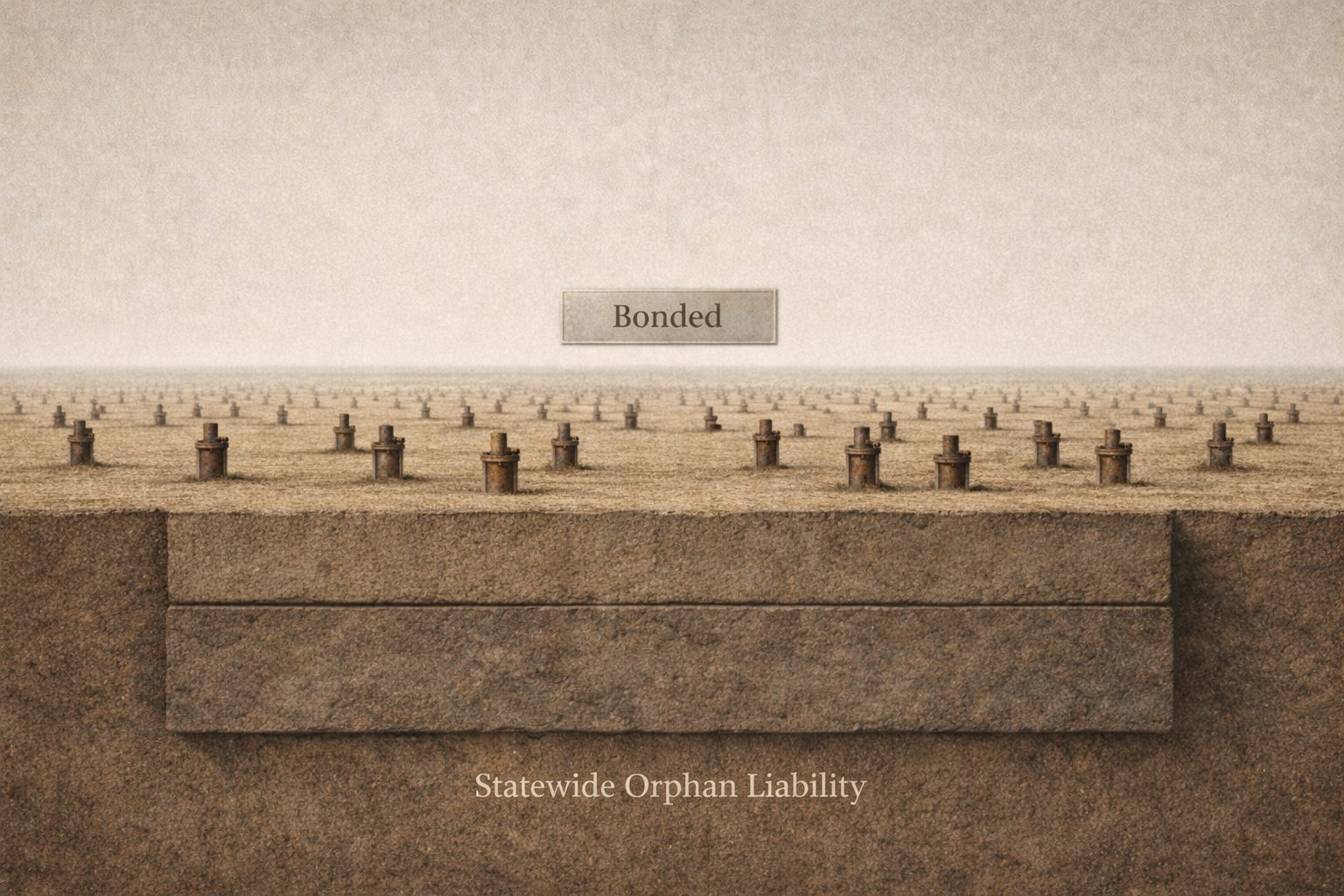
Across the United States, states are inheriting tens of billions of dollars in oil and gas cleanup costs. This isn't because wells were drilled illegally. It's because financial assurance was never designed to persist over long time horizons.
Bonding frameworks assumed wells would be plugged once and remain secure indefinitely. They didn't account for long-tail failure risk, operator insolvency decades later, or inventories migrating to increasingly marginal owners. The result followed directly from those assumptions. When wells fail or operators disappear, the gap gets absorbed by taxpayers, landowners, and state agencies.
The previous installment explored why wells fail decades after plugging, not because of negligent abandonment, but because wells were never engineered, monitored, or financed as systems with long-duration uncertainty. That leads directly to the question addressed here. If long-tail failure risk was real all along, why was financial assurance never designed to cover it? This article examines why bonding requirements were never built to cover real remediation costs, how blanket bonds concentrate risk, and why the gap has persisted for more than half a century.
A $10,000 bond frozen in time
The Bureau of Land Management's minimum bond for an individual oil and gas lease on federal land was set at $10,000 when Dwight Eisenhower was president. That minimum remained unchanged until June 2024, a span of sixty-four years.
Adjusted for inflation, $10,000 in 1960 equals roughly $105,000 in 2024 dollars. In real terms, the bond lost approximately 90% of its purchasing power while remaining nominally fixed.
Statewide blanket bonds followed the same trajectory. A $25,000 minimum, also unchanged since the 1960s, allowed operators running hundreds or thousands of wells to maintain negligible per-well coverage.
This wasn't a rounding error. Bond levels were repeatedly carried forward unchanged through successive regulatory updates, despite steadily rising remediation costs.
Why blanket bonds exist
Blanket bonds emerged as an administrative convenience. Regulators reduced paperwork, and operators reduced capital lockup. The assumption was straightforward. Operators would plug wells as they depleted, ongoing production would fund abandonment, and bonds would serve as a backstop rather than the primary funding source.
That assumption stopped holding as the industry evolved. Consolidation shifted wells from well-capitalized majors to smaller independents. Marginal wells changed hands repeatedly, with each transfer weakening the financial position behind the liability. Blanket bonds that once covered a dozen wells expanded to cover hundreds or thousands, while bond amounts remained fixed. Liability scaled with inventory size, while financial assurance did not.
The cost-to-bond arithmetic
A few numbers matter more than any narrative framing:
- 84% of federal well bonds are insufficient to cover reclamation costs (GAO).
- Average plugging costs range from $35,000 to $200,000 per well.
- Median total cost including surface reclamation is approximately $76,000 per well (RFF).
- Typical per-well bond coverage on federal lands has fallen to roughly $2,100.
A $10,000 bond against a $71,000 obligation provides about 14% coverage. A $25,000 statewide bond covering one hundred wells with $7.1 million in aggregate liability provides four-tenths of 1% coverage. Nationally, more than two million unplugged abandoned wells imply remediation liabilities approaching $280 to $300 billion. Bonds set at a few thousand dollars per well leave a structural shortfall rather than an edge case.
How blanket bonds concentrate risk
Blanket bonds allow a fixed amount to cover an unlimited number of wells, so coverage ratios deteriorate as inventories grow. Carbon Tracker's analysis of New Mexico illustrates the extreme case.
The state's largest operator, Hilcorp Energy Corporation, controls over 11,500 unplugged wells, roughly 15% of New Mexico's inventory. Estimated plugging liability is approximately $1.2 billion. Total bond coverage across federal, tribal, and state regulators amounts to roughly $1.55 million, or 0.13% coverage.
When large operators fail, bonding recovers almost nothing. Cleanup costs migrate to states and, ultimately, federal programs such as the $4.7 billion Orphan Well Program, which addresses only a fraction of total liability.
What bond failure looks like in practice: Colorado
During fiscal year 2024, Colorado took control of 551 orphaned wells from just two operators. Those wells represented 96% of the state's total orphan intake that year. Omimex Petroleum accounted for 339 wells and WME Yates LLC for 212.
WME Yates had assured regulators it held $255,000 in financial assurance. At Colorado's average plugging cost of approximately $93,000 per well, its wells carried nearly $20 million in liability, which works out to roughly 1.3% coverage.
The consequences weren't abstract. Bledsoe Cattle Company testified that improperly managed wells damaged irrigation systems and crops, causing approximately $17,000 in losses. The operator never appeared. Fines were assessed and never paid.
Colorado plugged 132 orphaned wells last year at a cost of nearly $15 million. At that rate, clearing the existing backlog would take seven years, assuming no new wells are orphaned.
Texas and the blanket bond cap
Texas caps inactive-well bonding at $2 million per operator, regardless of inventory size. Carbon Tracker analyzed the state's fifteen largest operators.
Plugging liabilities ranged from $67 million to $374 million, yet every operator capped bonding at $2 million. Coverage ratios clustered between 1 and 3%. Across all fifteen operators, $30 million in bonds secure over 17,000 inactive wells, or less than $2,000 per well against estimated plugging costs averaging $155,000. As Carbon Tracker observed, this structure provides an effectively unlimited option to defer plugging at minimal cost.
State-by-state variation
- Pennsylvania: $2,500 per conventional well or $25,000 blanket. Pre-1985 wells carry no bonding at all. Coverage remains below 0.5%.
- Oklahoma: A $25,000 blanket bond covers unlimited wells statewide.
- Louisiana: Roughly 75% of wells are exempt from bonding entirely.
- California: Escalating idle-well requirements coexist with approximately 35,000 idle wells, 58% of which are located in high-poverty communities.
- Colorado: Tiered inactive bonds cover roughly 14% of estimated cost. Total liabilities exceed $650 million.
Despite wide variation in state bonding rules, the outcome is consistently the same.
Federal reform, partial and late
In April 2024, BLM finalized its first major bonding update since 1988. The individual lease minimum increased from $10,000 to $150,000, the statewide minimum increased from $25,000 to $500,000, and nationwide bonds were eliminated. Phase-in now runs through June 2027, with inflation adjustments every ten years.
These reforms materially improve coverage on federal lands. Most wells, however, are located on state and private lands where bonding remains largely unchanged.
Why the gap persisted
Raising bonds imposes direct capital costs. When regulators propose increases, industry opposition typically centers on small-operator viability, premature abandonment of marginal wells, and local employment impacts. These arguments carry political weight in producing states, and the result has been deferred reform, frozen requirements, and statutory barriers to adjustment.
Pennsylvania's decade-long moratorium on bonding increases reflects a deeper avoidance of the core question: should financial assurance reflect real remediation costs? Answering yes forces difficult tradeoffs, and for decades the question remained largely unaddressed.
Alternatives exist, but remain partial
Mechanisms that could supplement or replace traditional bonding include pooled industry funds, escrow accounts funded during production, per-well fees dedicated to orphan mitigation, third-party guarantees, and specialized insurance products. None have been implemented comprehensively enough to close the gap. Most operate on top of inadequate bonding rather than in place of it.
What the numbers mean
Landowners face uncompensated damage when operators vanish, often discovering contamination only after crops fail or water tests return abnormal results. Investors inherit asset retirement obligations that were never fully priced into acquisitions. States divert general funds and federal grants to cover liabilities that were once private, while regulators attempt to manage growing inventories using tools designed for a very different industry. When bonding fails, the costs don't disappear. They shift onto the public.
The structural problem
Bonding captures liability at a single moment and assumes plugging is permanent. There's no mechanism to account for long-tail failure risk, post-closure degradation, or operator insolvency decades later. This architecture made sense when wells were shallow, lifespans were short, and balance sheets were deep. None of those conditions hold today. The system isn't broken so much as functioning exactly as it was designed to.
Where this leads
Closing the bonding gap requires either financial assurance that reflects real, long-duration costs or alternative mechanisms that accumulate reserves over time without immobilizing capital. Federal reforms are underway, but state systems lag far behind. The open question is no longer whether the current framework is adequate. It's how long the framework will remain in place despite mounting evidence that it isn't.
Next in the series: Article 6: "Risk-Based Triage and the Illusion of Control: How Abandoned Wells Are Prioritized and Why the Bonding Gap Persists"
Sources and Further Reading
U.S. Government Accountability Office (2019). Oil and Gas: Bureau of Land Management Should Address Risks from Insufficient Bonds to Reclaim Wells. GAO-19-615. https://www.gao.gov/products/gao-19-615
Carbon Tracker Initiative (2020). Billion Dollar Orphans. https://carbontracker.org/reports/billion-dollar-orphans/
Resources for the Future (2023). Decommissioning Orphaned and Abandoned Oil and Gas Wells. https://www.rff.org/publications/journal-articles/decommissioning-orphaned-and-abandoned-oil-gas-wells/
Colorado Public Radio (2024). https://www.cpr.org/2024/09/17/colorado-oil-and-gas-companies-orphaned-a-record-number-of-wells/