
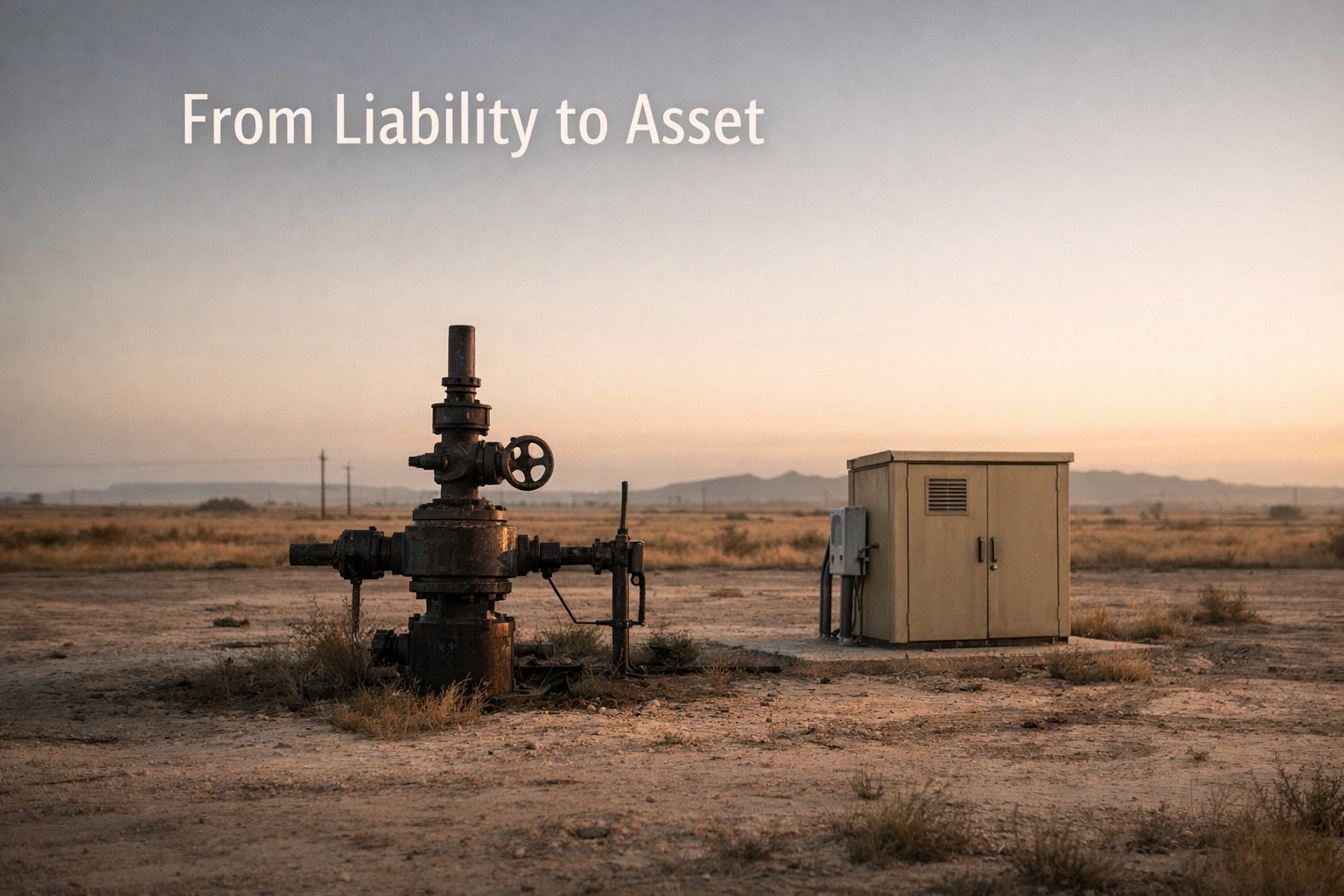
This is Article 14 in an ongoing series examining America's abandoned and orphaned well problem.
Most of this series has focused on what goes wrong when wells are left behind: integrity failures, contamination, unfunded liabilities, regulatory gaps, and a remediation industry still scaling up to meet the demand.
This article looks at the opposite question. Instead of plugging every abandoned well and walking away, can some of them be put back to work?
The idea is straightforward enough. Millions of wells already reach thousands of feet into the earth. The drilling is done, and roads, pad sites, and electrical connections are already in place. In many cases, there's detailed subsurface data from decades of production history. If even a fraction of those wells could be converted into geothermal heat sources, energy storage systems, or carbon injection sites, the economics of the abandoned well problem could shift from pure cost to partial value recovery.
Several pilot programs, a handful of startups, and at least two new state laws are now testing whether that idea holds up in practice.
Geothermal: the most obvious fit
The overlap between abandoned oil and gas wells and geothermal energy isn't a new observation. Oil and gas operators have been encountering hot water at depth since the first rotary rigs went down. The difference is that for most of that history, downhole heat was a nuisance rather than a resource.
That's starting to change. In January 2022, the U.S. Department of Energy selected four projects under its Wells of Opportunity initiative, awarding up to $8.4 million to demonstrate geothermal energy and heat production from inactive or unproductive oil and gas wells. The projects range from electrical power generation at an abandoned oilfield in Nevada to direct heating for elementary and middle schools in Tuttle, Oklahoma, using four nearby hydrocarbon wells.
The Oklahoma project is worth pausing on. It doesn't require exotic technology or frontier-scale investment. It takes existing wells, circulates water through formations that are already warm, and delivers heat to buildings that need it. The infrastructure and the geology were already there, and the only thing that changed was someone deciding those wells might still be useful.
A 2025 study by Boutot and Kang at McGill University examined the conversion potential of abandoned and orphaned wells across the United States and Canada. Their findings help put realistic boundaries on the opportunity. More than 90% of abandoned wells with available depth data are better suited for shallow geothermal systems and direct-use heating applications rather than electricity generation. Deep geothermal, the kind that can produce meaningful electrical power, is possible at roughly 10% of wells. The constraint is temperature. Most abandoned oil and gas wells sit in sedimentary basins where formation temperatures simply don't reach the thresholds needed for efficient power conversion.
That doesn't make the opportunity small. Direct-use geothermal heating for schools, municipal buildings, greenhouses, and district heating systems is commercially viable today in the right settings. It just means the vision of turning millions of abandoned wells into power plants isn't realistic. The realistic version is more targeted and more modest, and it depends heavily on whether the wellbore in question is still structurally sound enough to circulate fluid safely over decades.
A well that failed its original integrity obligations isn't a good candidate for a second career in geothermal. The same degradation mechanisms that this series has documented, including cement shrinkage, casing corrosion, and annular flow paths, apply equally to a repurposed well operating under different pressure and temperature cycling regimes.
Energy storage: a newer idea with real engineering behind it
A second category of well repurposing has gained traction in the last few years, and it doesn't depend on subsurface temperature at all.
Renewell Energy, a California-based startup, has developed a gravity-based energy storage system that uses the vertical depth of idle oil and gas wells as the storage medium. Mechanically, it's simple. A heavy cylindrical weight, made from used oilfield tubing and high-density filling, is raised and lowered inside the wellbore using a motor-generator. When excess electricity is available on the grid, the weight is lifted. When power is needed, the weight descends and the generator produces electricity.
The approach works because abandoned wells are deep. The average U.S. oil and gas well reaches roughly 5,200 feet. That vertical range provides far more gravitational potential energy per kilogram of weight than any above-ground gravity storage system can achieve. Renewell estimates individual wells can store between 40 and 500 kilowatt-hours depending on depth, with a capital cost target of $5 per kilowatt-hour, a fraction of current lithium-ion battery costs.
There's an environmental angle too. Up to 40% of idle wells have been found to leak methane. Renewell's installation process includes sealing the well above the depleted reservoir before deploying the gravity system, which means each conversion also eliminates a methane emission source. The company claims this makes its technology the only energy storage system with a net-negative carbon footprint over its lifecycle.
Compressed air energy storage in wellbores is also under investigation. A Penn State research team demonstrated a 9.5% improvement in round-trip efficiency for compressed air storage using wellbore geometry, suggesting that the unique dimensions of oil and gas wells could improve the economics of a storage technology that has struggled to compete at surface-level scale.
These are early-stage ventures. Renewell has built prototypes and presented at industry conferences, but the technology hasn't been deployed at commercial scale yet, and the compressed air work remains in the research phase. Still, the underlying logic seems sound. Wells are deep vertical structures with existing surface connections to the electrical grid, so if the engineering holds up, they're unusually well-suited for certain kinds of energy storage.
Carbon capture and storage: the integrity question
A third repurposing pathway involves using abandoned or depleted wells for CO2 injection. The appeal is that these wells already penetrate the subsurface formations where carbon could theoretically be stored, and the geology is well-characterized from decades of production data.
Recall that Article 4 documented how well integrity degrades over time. Cement develops micro-annular gaps, casing corrodes, and seals that were adequate under original operating conditions may not hold under different pressures, temperatures, or chemical environments. If abandoned wells can't reliably contain the methane and brine already present in their formations, then whether they can safely contain injected CO2 over geological timescales deserves hard questioning.
CO2 is more corrosive than methane in the presence of water. It forms carbonic acid, which accelerates casing and cement degradation. Injecting it into wellbores that may already have compromised barriers is a different proposition than injecting into purpose-drilled wells with modern completions. The monitoring requirements alone would be substantial, and the liability exposure for a storage site that leaks would fall on someone, though current law offers little clarity on who.
This doesn't rule out the concept entirely, but it does mean that any serious CO2 storage program using legacy wells will need to demonstrate containment assurance at a level the existing well stock was never designed to provide. For now, purpose-built Class VI injection wells remain the more defensible path for large-scale carbon sequestration.
The regulatory picture is just starting to form
Until recently, there was no clear regulatory pathway for converting an oil and gas well into anything other than a plugged hole.
That changed in April 2025 when New Mexico Governor Michelle Lujan Grisham signed House Bill 361, the Well Repurposing Act. The law grants the state's Energy, Minerals and Natural Resources Department authority to authorize the conversion of oil or gas wells into facilities for energy storage or geothermal energy development. It also allows the department to establish fees and financial assurance requirements specific to those new uses.
Representative Andrea Romero, the bill's sponsor, framed the opportunity directly. New Mexico has nearly 2,000 orphaned wells sitting unused and posing pollution risks, and HB 361 creates a legal path to repurpose those assets rather than simply plugging them.
North Dakota passed similar legislation in 2025 through Senate Bill 2360, which also provides for the conversion of hydrocarbon wells to geothermal use.
Two states isn't a national framework, but it's a signal that legislatures are beginning to recognize that plug and abandon may not be the only endpoint for every well. The regulatory gap remains significant. Most states have no permitting structure for well conversion, and liability questions are largely unresolved. If a well converted to geothermal use develops a leak five years later, is the original operator liable? The conversion company? The state? Those questions haven't been tested in court, and the answers may vary by jurisdiction.
The reality on conversion potential
It's important to be direct about what well conversion can and cannot do.
The United States has an estimated 2.2 to 3.9 million abandoned wells. Even the most optimistic assessments of conversion potential suggest that only a fraction of those wells are candidates for repurposing. The well has to be structurally sound, which eliminates a large share of the oldest and most deteriorated inventory. It has to be in a location where geothermal temperature gradients, grid connections, or geological storage capacity make conversion viable. And it has to make economic sense compared to the cost of conventional plugging and reclamation.
The Boutot and Kang study found substantial wind and solar energy potential at abandoned well sites, identifying more than 15,000 gigawatts of wind capacity and 7 gigawatts of solar capacity across the U.S. and Canada. Those numbers describe the sites, not the wells themselves. Repurposing the disturbed land for renewable energy generation doesn't require the wellbore to be intact. It does require the surface to be cleared and remediated, which circles back to the plugging and reclamation work the series has been examining all along.
Well conversion won't solve the abandoned well crisis. It's not a substitute for adequate bonding, functional regulatory systems, or a scaled-up remediation industry. What it can do is change the framing. If some wells have residual value as energy infrastructure, then managing them as long-term assets rather than writing them off as waste becomes a more natural way to think about the problem. That shift, from neglect to active management, is one of the core arguments this series has been building toward.
Questions for readers
If you work in energy transition, geothermal development, or well operations, I'm interested in how you see these conversion pathways in practice:
- Have you evaluated specific wells for geothermal conversion or energy storage? What were the deciding factors for or against?
- How do you see the liability question playing out for converted wells?
- Does the current regulatory landscape in your state support or hinder well repurposing?
The next article examines how carbon credit markets are beginning to assign monetary value to the emissions avoided by plugging abandoned wells.
Sources and Further Reading
The sources below support the technical, legislative, and research claims discussed in this article. They are provided so readers can trace the primary references directly.
DOE Wells of Opportunity program
U.S. Department of Energy (2022, January 12). DOE Awards $8.4 Million for Accessing Geothermal Potential from Inactive or Unproductive Oil and Gas Wells. https://www.energy.gov/eere/articles/doe-awards-84-million-accessing-geothermal-potential-inactive-or-unproductive-oil-and
U.S. Department of Energy (n.d.). Going Back to the Well (Again): Harnessing Geothermal Energy's Potential. https://www.energy.gov/hgeo/geothermal/articles/going-back-well-again-harnessing-geothermal-energys-potential
Peer-reviewed research
Boutot, J., & Kang, M. (2025). Renewable energy production potential of abandoned and orphaned oil and gas wells and sites. Environmental Research Letters, 20, 054037. https://doi.org/10.1088/1748-9326/adc6a0
Santos, L., Dahi Taleghani, A., & Elsworth, D. (2022). Repurposing abandoned wells for geothermal energy: Current status and future prospects. Renewable Energy, 194, 1288-1302. https://doi.org/10.1016/j.renene.2022.05.138
State legislation
New Mexico Legislature (2025). HB 361: Well Repurposing Act. https://www.nmlegis.gov/Sessions/25%20Regular/final/HB0361.pdf
Think GeoEnergy (2025, April 9). Bill on repurposing oil and gas wells to geothermal passed in New Mexico, US. https://www.thinkgeoenergy.com/bill-on-repurposing-oil-and-gas-wells-to-geothermal-passed-in-new-mexico-us/
Energy storage and well repurposing technology
Renewell Energy (n.d.). Gravity Well Technology for Energy Storage. https://renewellenergy.com/gravity-well-technology-for-energy-storage/
National Academies workshop
National Academies of Sciences, Engineering, and Medicine (2025). Practices and Standards for Plugging Orphaned and Abandoned Hydrocarbon Wells: Proceedings of a Workshop. https://nap.nationalacademies.org/
*n.d.: no date
*Sources emphasize primary government, peer-reviewed, and legislative references; numerical values reflect publicly reported ranges and may vary by year or jurisdiction.