
This is Article 13 in an ongoing series examining America's abandoned and orphaned well problem.
Articles 11 and 12 covered funding and the regulatory patchwork. This one is about the people and companies who actually show up and do the work, and why cleanup doesn't scale as fast as the headlines suggest. The bottleneck isn't always money.
The question I keep hearing is why the work isn't moving faster if the money is there. The short answer is that money doesn't create crews, rigs, disposal capacity, or multi-year certainty. It helps, but it has to land in an industry that can absorb it.
A growing market, still a patchwork
Plugging and abandonment has become its own steady category of work in many states, driven more by regulation, liability exposure, and public programs than by commodity prices. But it doesn't scale the way drilling or completions do.
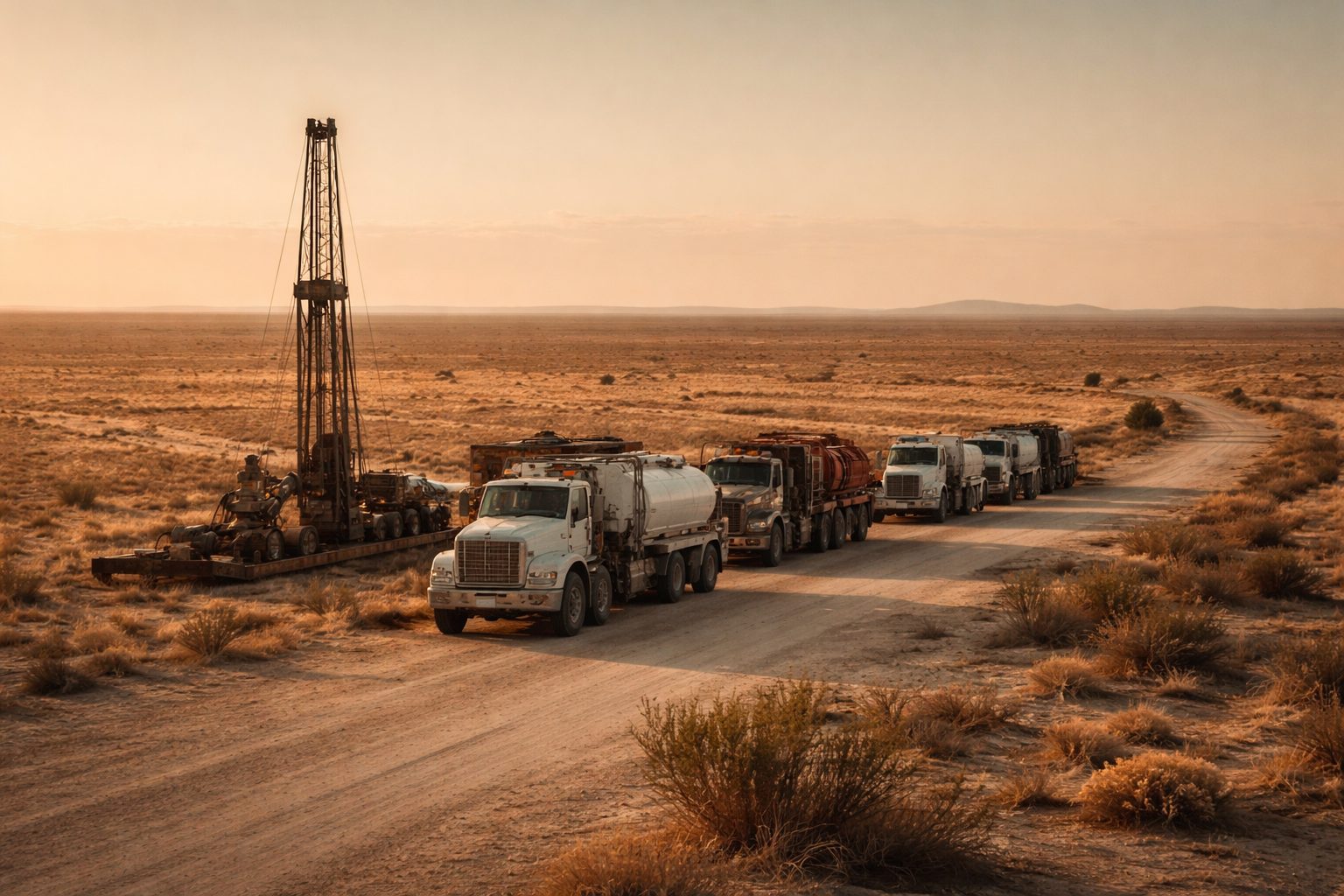
Most P&A work runs through regional contractors who understand local well types, local rules, and local access conditions. A crew that knows the Permian doesn't automatically know how to handle 1890s-era Pennsylvania wells with no records and deteriorated casing in acidic mine water. That kind of knowledge gets built over years, and you can't spin it up in a quarter. So when federal funding surges, the regions that already had contractors staffed can move, and the regions that didn't get bottlenecked.
There's been some effort to build larger, more consolidated platforms. The JMR Services and A-Plus P&A merger was positioned as a step toward national pure-play P&A capacity. I think the concept makes sense. Whether it holds together through the inevitable funding gaps is a different question, and one that hasn't been tested yet.
On the technical side, companies are experimenting with approaches for wells that don't respond to conventional cement placement: wells with microannuli, sustained casing pressure, or cement channels that conventional squeeze jobs can't seal. BioSqueeze's biomineralization approach is one example, and resin-based sealants are another. Some of these will work at scale, and some will turn out to be lab results that don't translate to field conditions with any consistency. I don't have a strong view on which ones survive, but the experimentation matters because the subset of problem wells isn't small.
What plugging actually costs
People tend to talk about cost per well as if it's a fixed number. It isn't. There's a median and a long tail, and the tail can run more than an order of magnitude above the median.
Peer-reviewed analysis using roughly 19,500 wells puts the median around $20,000 for plugging only, and about $76,000 when surface reclamation is included. The spread is wide, and a small share of wells push past $1 million. Cost drivers include depth (roughly +20% per 1,000 feet), well type (+9% for gas versus oil), and whether you can batch wells geographically (about -3% per additional well in a cluster). That last factor matters more than people realize. A contractor running a batched program across a tight geographic area can keep mobilization and demobilization costs down and maintain crew rhythm. Scattered one-off wells with individual mobilization cycles and unpredictable downhole surprises blow up the economics fast.
Federal land wells tend to land on the higher end. BLM planning documents put plugging and reclamation averages in the $112,500 to $180,000 range per well, reflecting older infrastructure, difficult access, and full reclamation requirements.
Then there are the outliers that have nothing to do with routine P&A. A blowout near Odessa in late 2023 ran roughly $2.5 million for a single well. That was a well-control incident, and it's the kind of event that bonding is supposed to cover but rarely does at current levels.
Why surge funding doesn't produce surge results
The way public funding works here creates a structural problem for contractors. A grant cycle gets announced, procurement and rulemaking take months, and then states start letting contracts. By the time work actually begins, rules may have already shifted or the next timeline is unclear. Contractors have to decide whether to hire, buy equipment, and build safety systems for work that might evaporate in 18 months.
Most of the time, that math doesn't work, so experienced crews take other work when a funding gap opens up. When money comes back, you can't just reassemble those crews on short notice. Ohio's ODNR has said publicly that attracting and retaining contractors has been one of its biggest challenges. Pennsylvania's experience tells a similar story. Average plugging costs under state contracts from 2014 to 2023 were around $50,000 per well. After the IIJA contract was issued, costs jumped to roughly $106,000 per well. That's a typical supply-demand response. When every state ramps simultaneously, the same rigs, cementing crews, and experienced supervisors get bid up everywhere.
The inputs that matter most are the ones that take longest to build, namely people who can run compliant operations at volume on unpredictable wells. You can buy a rig, but you can't buy twenty years of field judgment on 1940s-era wells with no cement records.
The workforce problem nobody puts in the press release
Published job numbers from P&A programs look impressive in a headline. What actually determines execution capacity on any given day is whether the right people are available and staying.
This work requires crews who can operate safely around decades-old infrastructure where the records are often incomplete or just wrong. It's rig operations, cementing, well control, regulatory compliance, and surface reclamation, all wrapped together with the kind of field judgment that only comes from years of handling unexpected conditions. In producing states, the people best suited for this work are often the same people who drilled and operated these wells in the first place. That overlap isn't a coincidence, and I think it's something program designers should be building around deliberately rather than treating as incidental.
Pennsylvania's registered apprenticeship program tied to well plugging is worth watching. RFF has estimated that plugging roughly 500,000 wells could support around 120,000 jobs. If this problem runs for multiple decades, and I think it will, then treating workforce development as a byproduct of a single grant cycle is going to keep producing the same capacity gaps we see now. The training pipeline has to match the time horizon of the liability.
Where I think this is headed
Nobody is building a single national plugging operation. The wells are too scattered, the well types are too variable, and state regulatory frameworks differ enough that a uniform national contractor model wouldn't work even if someone tried.
What I expect instead is continued regional specialization, with selective consolidation where firms can get multi-year contract visibility. Batching and logistics improvements will bring incremental cost reductions. Alternative sealing approaches like biomineralization and resin systems will get adopted for the subset of wells where conventional cement placement keeps underperforming, which based on what I've been hearing is a bigger subset than most people assume.
The structural question that hangs over all of this is whether state and federal programs shift toward long-duration, steady-rate infrastructure management or keep running periodic sprint-and-stall cycles. Everything I've described in this article, the workforce gaps, the cost spikes, the contractor retention problem, traces back to that question. Steady annual programs with multi-year contracting give the private sector enough certainty to invest in real capacity. The pattern to date has mostly been burst funding, and the results reflect it.
If you're in this work, I'd like to hear what you're seeing
I've laid out what I think the structural problems are. But I'm writing from the analytical side, and the people closest to the operational constraints are the ones running crews, managing state programs, and making investment decisions in this market.
What's actually limiting throughput right now? I hear different things from different regions. In some places it's crews, in others it's disposal logistics or permitting timelines, and for some contractors the issue is contract structure more than anything else. State program managers, I'm curious whether you see a measurable difference in execution quality between contractors who stay in this market between funding cycles and firms that rotate in when money appears. And for anyone watching this from an investment angle, what would it take for regional P&A platforms to hold together through a down cycle?
Sources and Further Reading
The sources below support the market, cost, workforce, and capacity points discussed in this article. They are provided so readers can trace the primary references directly.
Industry structure and consolidation
Business Wire (2024).
JMR Services and A-Plus P&A announce strategic merger to create a national pure-play P&A platform.
https://www.businesswire.com/news/home/20240305554332/en/JMR-Services-and-A-Plus-PA-Announce-Strategic-Merger-to-Create-the-Leading-Pure-Play-PA-Service-Provider-in-the-Nation
JMR Services (2024).
JMR merges with A-Plus P&A and acquires BCM & Associates (company announcement).
https://www.jmrservices.com/post/jmr-merges-with-a-plus-p-a-llc-and-acquires-bcm-associates-inc
Alternative sealing approaches and field remediation constraints
BioSqueeze (undated).
Leaking plugs: biomineralization approach and use case description.
https://biosqueeze.com/application/leaking-plugs/
What plugging costs and why the tail matters
Raimi, D., Krupnick, A., Shah, J.-S., & Thompson, A. (2021).
Decommissioning orphaned and abandoned oil and gas wells: New estimates and cost drivers (Environmental Science & Technology).
https://pubs.acs.org/doi/10.1021/acs.est.1c02234
Resources for the Future (2021).
Summary of key cost drivers from the Raimi et al. analysis (median costs, depth effect, gas vs oil, and other drivers).
https://www.rff.org/news/press-releases/new-study-reveals-key-factors-for-estimating-costs-to-plug-abandoned-oil-and-gas-wells/
Federal-land cost assumptions
U.S. Bureau of Land Management (2023, June).
Supporting statement in the BLM financial assurance rule docket, including the frequently cited $112,500 to $180,000 per-well average range used for planning.
https://downloads.regulations.gov/BLM-2023-0005-0002/content.pdf
When "one well" becomes a well-control incident
The Texas Tribune (2025, May 8).
Texas struggles to clean up abandoned oil and gas wells (includes the Odessa-area blowout example and cited containment and plugging costs).
https://www.texastribune.org/2025/05/08/texas-orphan-wells-explained-railroad-commission-abandoned/
Inside Climate News (2024, Feb 29).
Background reporting on the same West Texas incident and response costs.
https://insideclimatenews.org/news/29022024/abandoned-oil-wells-west-texas-railroad-commission/
Program capacity, procurement, and contractor availability
Ohio Auditor of State (2022, Aug 9).
Performance audit of ODNR's Orphan Well Program (useful for how the program is structured and where execution bottlenecks show up, including reliance on third-party contractors).
https://ohioauditor.gov/auditsearch/Reports/2022/Ohio_Department_of_Natural_Resources_22_Performance-Franklin_FINAL.pdf
Pennsylvania cost step-change under IIJA-era contracting
National Academies of Sciences, Engineering, and Medicine (2025).
Practices and Standards for Plugging Orphaned and Abandoned Wells: Proceedings of a Workshop (chapter excerpt citing PA DEP discussion of roughly $50k average under 2014–2023 state contracts versus roughly $106k after the IIJA contract).
https://www.nationalacademies.org/read/28035/chapter/4
Spotlight PA (2024, Feb 26).
Reporting on IIJA-funded plugging and observed average costs on recent projects (context for the post-IIJA cost environment).
https://www.spotlightpa.org/news/2024/02/pennsylvania-abandoned-oil-gas-wells-federal-plugging-climate-change/
Workforce development and job-years estimates
Resources for the Future (2021, July 14).
Plugging abandoned wells: effects of the draft Energy Infrastructure Act (includes the "120,000 job-years to plug 500,000 wells" estimate cited in the article).
https://www.rff.org/publications/issue-briefs/plugging-abandoned-wells-effects-of-the-draft-energy-infrastructure-act/
Resources for the Future (2020, July 20).
Green stimulus for oil and gas workers: considering a major federal effort to plug orphaned and abandoned wells (jobs framing and implementation constraints).
https://www.rff.org/publications/reports/green-stimulus-oil-and-gas-workers-considering-major-federal-effort-plug-orphaned-and-abandoned-wells/
Pennsylvania Governor's Office (2024, Aug 8).
Workforce investments and apprenticeship context tied to Pennsylvania's broader training pipeline (UMWA career center event).
https://www.pa.gov/governor/newsroom/2024-press-releases/governor-shapiro--labor-leaders-visit-umwa-career-center-in-gree.html
The Times Leader (2024, Aug 26).
State announces registered apprenticeship program to plug abandoned oil and gas wells (local coverage of the apprenticeship announcement).
https://www.timesleader.com/news/1665354/state-announces-apprenticeship-program-to-plug-abandoned-oil-gas-wells