
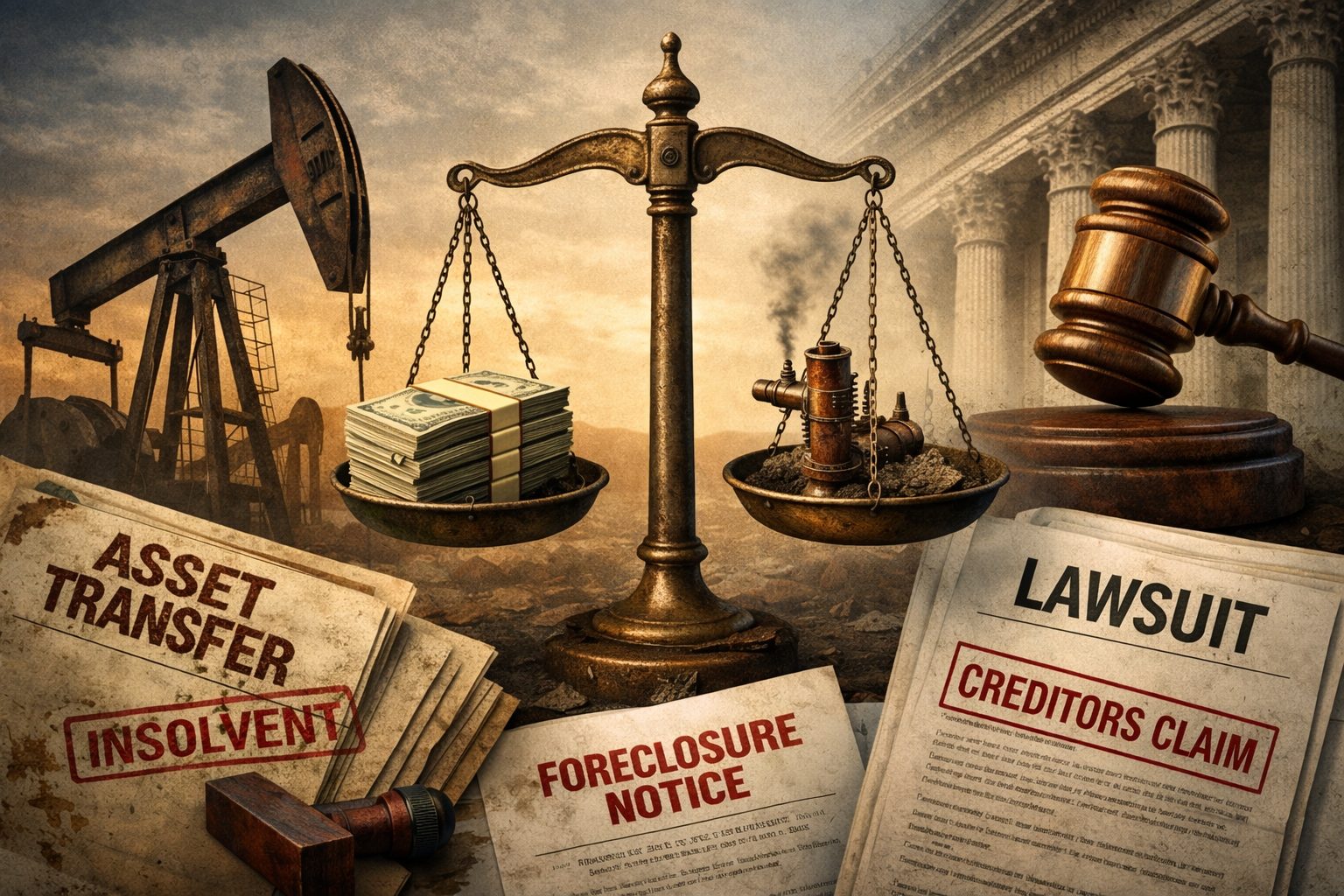
This is Article 9 in an ongoing series examining America's abandoned well crisis. The first eight articles outlined the scale of the problem, why old wells fail, and how regulatory and financial gaps leave many wells orphaned. This installment shifts to a new legal lens. It doesn't moralize about industry behavior or call for sweeping reforms. Instead, it looks at a structural quirk in the system: how plugging liabilities can disappear through corporate transactions, and how recent court cases are exposing that design flaw.
The question worth asking is why a routine sale of aging wells would spark a lawsuit years later. The answer is that courts are now treating future well-plugging obligations like debts that can't be shed by transferring assets to an underfunded shell. The issue is no longer just who neglected to plug a well, but whether the system let the liability slip through legal cracks.
How the Problem Surfaced in Court
In July 2022, a group of West Virginia landowners noticed something unsettling about the idle gas wells dotting their properties. These wells had changed hands in a 2018 deal, sold by a major operator, EQT Corporation, to a smaller company, Diversified Energy, along with thousands of others. On paper, the transfer was a legitimate business transaction. But as time passed, few of the acquired wells were being plugged, and the new owner's pace of cleanup implied a timeline of centuries, not years.
Digging into public filings, landowners and analysts found a stark imbalance. EQT had sold roughly 12,000 old wells for about $700 million, while the estimated plugging cost for those wells ran on the order of $2 to $3 billion. The sale price covered only a fraction of the environmental liability being transferred, and that discovery challenged an assumption that had long gone unquestioned in oil and gas deals.
The liability figures here represent aggregate, portfolio-level exposure, not average per-well plugging costs. These estimates reflect forward-looking remediation risk used in transaction analysis and litigation, and they may include surface reclamation, infrastructure removal, long-tail monitoring, and uncertainty buffers. Actual mechanical plugging costs vary widely by well condition, access, and jurisdiction, and they're often materially lower when performed by operators under approved programs.
The Assumption That No Longer Holds
For decades, the industry operated on an implicit assumption: when a well is sold to a new operator, the duty to plug it passes cleanly to the buyer and ends there. Regulators treated transfers the same way, approving the change of operator, updating the paperwork, and trusting that the new owner would eventually meet all end-of-life obligations. That assumption held as long as the acquiring companies stayed solvent and accountable.
What the West Virginia case revealed is that the assumption breaks down when wells are transferred precisely because their cleanup costs exceed their value. If a company can rid itself of expensive obligations by selling wells to a thinly capitalized firm, the duty to plug can effectively evaporate. The wells linger, orphaned in all but name, while the original seller has cashed out. Until recently, the legal system didn't recognize the surface owners or the public as having any claim in such deals, which is a critical visibility gap. That gap is exactly what a new legal theory is now addressing.
How Liability Gets Shed Through Corporate Structure
The fraudulent transfer theory now being applied treats plugging liability as a debt that exists from the moment a well is drilled. Drilling a well inherently creates a future obligation to plug it, and landowners hold a contingent claim for that cleanup. If an operator transfers the well for less than the cost of that obligation, to an entity that can't possibly carry it out, the transaction can be treated as a fraudulent conveyance. In practice, that means the sale can be unwound or the seller held responsible for the unplugged well, much the way a debtor can't simply move assets beyond the reach of creditors.
A clear example is playing out in Colorado. HRM Resources, a mid-size operator, acquired hundreds of marginal wells from larger companies, then turned around and sent roughly 200 wells into a newly formed company, Painted Pegasus, in 2018. Painted Pegasus paid a token amount, just $305,000 in bonds against an estimated $17 million in cleanup costs, and then filed bankruptcy in 2021, shedding nearly 200 wells onto the state's orphan list. The pattern was hard to miss. The wells were financially upside-down, and creating a sacrificial company to take the fall was the chosen maneuver. The eventual lawsuit called it a "designed-for-bankruptcy" scheme. The liability didn't vanish by bad luck. It was stripped away through corporate structure.
Evidence from Landmark Cases and Investigations
McEvoy v. Diversified Energy (2024), the West Virginia case introduced above, became the first major test of this theory. Landowners sued Diversified and EQT, claiming the 2018 and 2020 well sales were constructively fraudulent because the plugging duty far exceeded the sale value. In April 2023, a federal judge agreed the case could proceed. The court recognized the landowners as creditors of the plugging obligation, a novel designation. Drilling a well, the court held, "necessarily gives rise" to a duty to plug, so surface owners have a legitimate, if long-term, claim on the company for that future work. Under state fraudulent transfer law, unloading wells to a party that can't fulfill that claim could be voided even without proof of intent to defraud.
It's worth being precise about what those rulings mean. Courts allowing fraudulent-transfer claims to proceed are evaluating procedural plausibility, not determining intent or liability. Language describing alleged schemes or designed outcomes comes from pleadings rather than judicial findings, and it should be read in that context. Recent cases suggest that long-tail environmental obligations may be treated as contingent claims for fraudulent-transfer analysis under specific fact patterns and jurisdictions. They don't establish universal treatment of plugging obligations as present-day debt across bankruptcy or regulatory frameworks.
Even with those caveats, the shift is significant: environmental obligations were legally framed as debts. The immediate result was a settlement in late 2024. Diversified Energy agreed to pay $6.5 million and, more importantly, to quadruple its plugging rate, committing to plug 2,600 wells by 2034 instead of the 580 it had originally scheduled. What had looked like somebody else's problem was reattached, at least in significant part, to the company that profited from the wells.
McCormick v. HRM Resources (2025), the Colorado case, is extending the precedent. After the Painted Pegasus bankruptcy orphaned 196 wells, Colorado surface owners led by plaintiff Scott McCormick sued in 2024, alleging the transfer was a fraudulent attempt to dump liabilities. In January 2025, Judge Charlotte Sweeney denied motions to dismiss and explicitly cited McEvoy's reasoning. She found it plausible that Painted Pegasus "was structured to go bankrupt and wash away HRM's liabilities." The court also held that individual executives could be personally liable if they orchestrated the scheme, without any need to pierce the corporate veil. That puts the CEO and other officers who conceived and approved the transfer strategy directly on the hook if the case succeeds. As of late 2025, the McCormick case had been certified as a class action and was moving into discovery, a strong signal that the courts see potential merit in the approach.
Beyond the courtroom, investigative reporting has shown these cases aren't isolated. The Capitol Forum's March 2023 investigation traced orphan well lists in Appalachia and found 203 orphan wells that had ties to major, active oil and gas companies. In West Virginia, at least 15 orphan wells were linked to Chesapeake Energy's past acquisitions, and a handful more to Diversified. In Kentucky, 25 orphan wells were attributed to Ashland Oil, a predecessor of today's Marathon and Equinor. Even New York's orphan wells included some originally drilled by Sinclair Oil, now part of BP. In each case, corporate mergers and sales over decades severed the link between the current solvent operator and the defunct entity left holding the bag. Regulators told the Capitol Forum that they lack the tools or authority to untangle these corporate lineage issues. Kentucky's oil and gas division said it has no statutory authority or resources to investigate corporate histories, and West Virginia's DEP acknowledged "no reliable method to identify every defunct well operator" in its files. In total, the investigation identified more than 104,000 inactive or abandoned wells across the region tied to some 9,600 still-active companies. Orphan wells, in other words, aren't only the legacy of long-dead wildcatters. They're often the collateral damage of perfectly legal corporate transactions over the last few decades.
Why This Failure Is Hard to Detect or Attribute
The erosion of liability through legal transfers stayed largely invisible for so long because it exploits gaps in time and data. A well might produce for decades, get sold several times as an uneconomic asset, and finally end up orphaned years after the decisive transaction. By the time a well appears on a state's orphan list, the trail of ownership is cold. Unless someone connects the dots backward through deed records, bankruptcy filings, or old regulatory reports, the link to a prior solvent owner is easy to miss. That's exactly what the Capitol Forum findings underscored: agencies weren't following corporate name changes or M&A trails as a matter of course.
Plugging obligations also don't carry a fixed due date. They sit in a gray area, and as long as a well isn't formally declared orphaned or abandoned, regulators treat the duty as resting with whatever operator is on file. If that operator quietly goes bankrupt or dissolves, the obligation only becomes apparent when the well starts leaking or a third party complains. In legal terms, the claim for plugging might not seem to mature until a well is left unplugged, by which point the responsible company could be long gone. That built-in delay made it easy for liability to slip through without any single dramatic event to trigger scrutiny. No alarms go off when a well transfer happens, even if that transfer all but guarantees a future orphan well. The alarm comes years later, when the well is found leaking or a landowner raises the issue, and by then the parties involved tend to argue it's all perfectly legal and in the past.
Implications for Liability and Remediation
What these developments reveal isn't a story of rogue operators defying the rules. It's a deeper design failure in how the system allocates long-term responsibility. The traditional framework assumed that a nominal bond and some paperwork for transfers were enough, essentially trusting that market players would act in good faith or that worst-case liabilities were theoretical. In reality, asset retirement obligations often outlast the corporate entities that incurred them, and the system had few safeguards for that scenario. Corporate and legal structures let liability be peeled away from assets without anyone technically breaking the rules. It's an institutional failure of oversight and design more than individual negligence.
That said, courts now willing to treat these maneuvers as fraudulent conveyances are changing the incentives. Buyers and sellers of wells are on notice that a deal structured mainly to offload future cleanup costs may not hold up under scrutiny. Several practical implications follow.
- M&A due diligence: Environmental liabilities can no longer be footnotes. Acquirers have to weigh actual plugging costs against what's on the books, and ask whether the purchase price is enough to cover a worst-case cleanup. If it isn't, they risk a later claim that the sale was constructively fraudulent. Thorough chain-of-title research matters too, since a past transfer in the well's history might itself be open to challenge.
- Executive accountability: McCormick signals that executives can't hide behind the corporate entity if they knowingly approve dumping liabilities. Personal exposure for orchestrating such transfers changes the calculus for any "creative" solution to distressed assets.
- Regulatory response: California's Orphan Well Prevention Act (AB 1167) now requires full-cost bonding when low-producing wells change hands, specifically to prevent underfunded transfers. Colorado tried to follow with SB24-159, which would have let the state pursue former owners for orphaned well cleanup costs, but the legislature killed the bill in committee in March 2024, so recovery from prior owners in Colorado still runs through the courts, which is what makes McCormick worth watching. West Virginia struck an unprecedented deal with Diversified in 2025, a $70 million public-private plugging fund. And New Mexico's Attorney General sued a network of shell companies and individuals in 2025 over a scheme to shed well liabilities through serial sales and bankruptcies.
- Financial assurance reform: The Bureau of Land Management updated its bonding rules in 2024, raising minimum bond amounts that had been stuck at 1960s levels. That doesn't directly stop fraudulent transfers, but it makes it harder for a buyer to post a token bond, like Painted Pegasus's 1.8 percent coverage, without scrutiny.
Taken together, the legal framework is catching up to the loopholes that let liabilities go missing. Landowners are now recognized as creditors with enforceable rights to see wells on their land properly retired. Asset sellers are learning that a quick exit deal can come back as a lawsuit. And investors are watching, because if plugging costs have to be honored eventually, they'll factor into valuations, loans, and insurance.
From Fraudulent Transfers to Bankruptcy Gaps
Fraudulent transfer litigation is starting to rein in liability-dumping during asset sales, but another route for shedding environmental obligations still looms large: bankruptcy. U.S. bankruptcy law has historically let companies walk away from unplugged wells and leave cleanup to the state. The very strategy of designing a spin-off to fail, as alleged in HRM's case, exploits that weakness. If courts are one battleground for accountability, bankruptcy courts are the next.
The next article examines how bankruptcy frameworks and corporate wind-downs make orphan well liabilities worse, and what can be learned from Canada's example, where the landmark Redwater case stopped bankrupt firms from abandoning wells without cleanup. The question is whether there's a workable blueprint for U.S. reform, one where environmental obligations aren't treated as just another unsecured claim to be discharged.
If you work in this space, I'd value your perspective. For M&A professionals, environmental attorneys, and regulators, how are you adjusting due diligence and policy in light of this precedent, and are plugging liabilities now front and center in deal valuations and enforcement? This is a fast-moving area, and on-the-ground experience is worth a lot.
Sources and Further Reading
The sources below provide legal and transactional context for the fraudulent conveyance and successor-liability concepts discussed in this article. They focus on primary case law, bankruptcy principles, and oil and gas–specific applications relevant to legacy well liabilities.
Core fraudulent conveyance and bankruptcy doctrine
Supreme Court of the United States (1939).
Pepper v. Litton, 308 U.S. 295 (1939).
https://supreme.justia.com/cases/federal/us/308/295/
Supreme Court of the United States (1988).
BFP v. Resolution Trust Corp., 511 U.S. 531 (1988).
https://supreme.justia.com/cases/federal/us/511/531/
United States Congress (n.d.).
11 U.S. Code § 548 – Fraudulent transfers and obligations.
https://www.law.cornell.edu/uscode/text/11/548
Uniform Law Commission (2014).
Uniform Voidable Transactions Act (UVTA).
https://www.uniformlaws.org/committees/community-home?CommunityKey=e40c73a3-0a0a-4c6f-b5b0-8aa9e4b7c20c
Oil and gas–specific bankruptcy and asset transfer analysis
Haynes and Boone (n.d.).
Oil Patch Bankruptcy Monitor (multi-year series).
https://www.haynesboone.com/-/media/project/haynesboone/haynesboone/pdfs/energy-reports/oil_patch_bankruptcy_monitor.pdf
Norton Rose Fulbright (2016).
Environmental liabilities in insolvency: implications for oil and gas.
https://www.nortonrosefulbright.com/en/knowledge/publications/1e8d94d8/environmental-liabilities-in-insolvency
Kirkland & Ellis (n.d.).
Fraudulent transfer risk in distressed M&A transactions.
https://www.kirkland.com/publications/kirkland-memos/2018/05/fraudulent-transfer-risk
Environmental liability and successor exposure
U.S. Environmental Protection Agency (n.d.).
Environmental obligations and bankruptcy.
https://www.epa.gov/enforcement/environmental-obligations-bankruptcy
U.S. Government Accountability Office (2019).
Oil and Gas: Bureau of Land Management Should Address Risks from Insufficient Bonding (GAO-19-615).
https://www.gao.gov/products/gao-19-615
Transactional diligence and liability allocation
American Bankruptcy Institute (n.d.).
Fraudulent conveyance litigation basics.
https://www.abi.org/abi-journal/fraudulent-conveyance-litigation-basics
Practical Law (n.d.).
Fraudulent transfer claims in asset sales.
https://content.next.westlaw.com/practical-law/document/I0f4d5e8aef0811e38578f7ccc38dcbee