
This is Article 10 in an ongoing series examining America's abandoned and orphaned well problem.
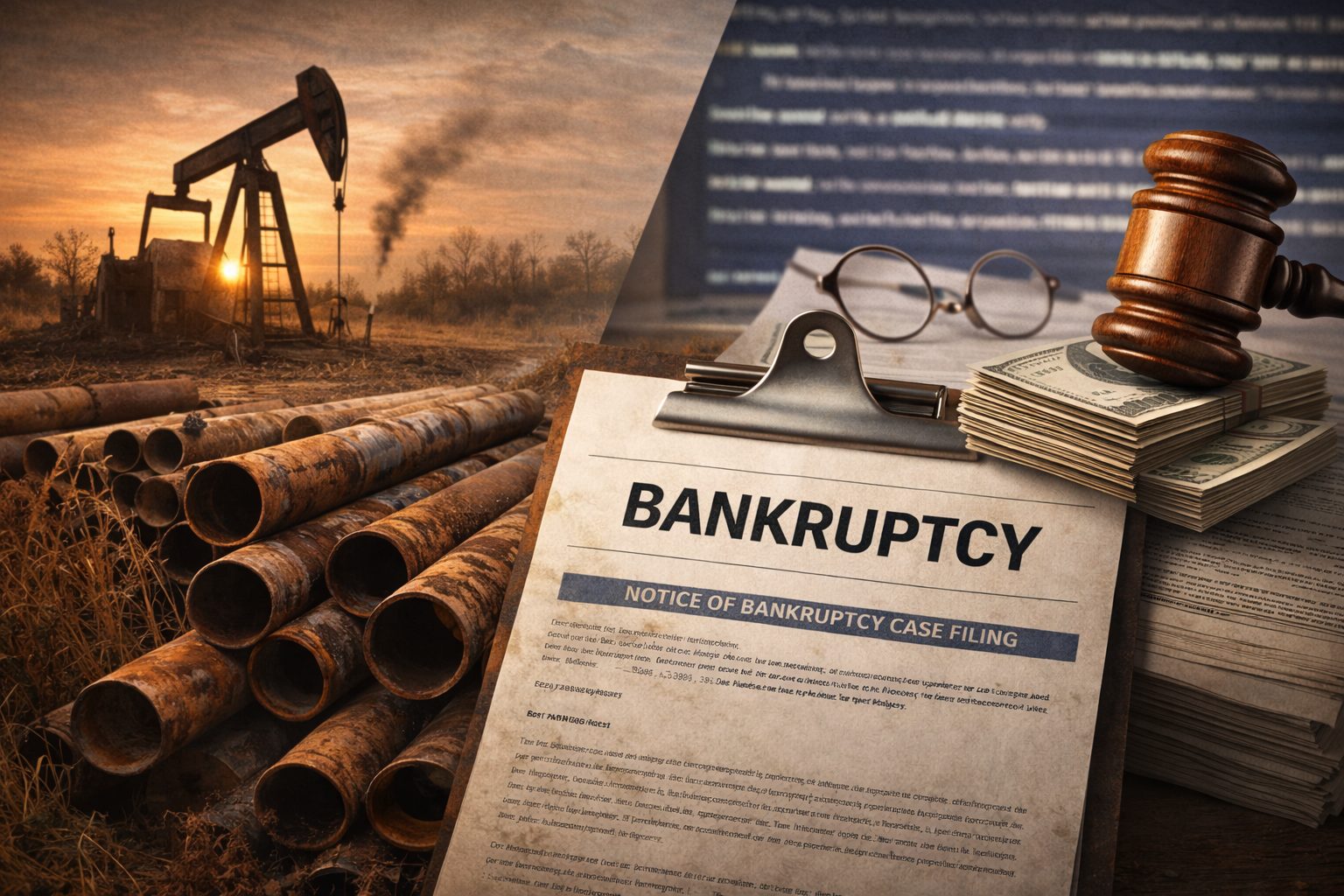
Most people picture an abandoned oil and gas well as a technical problem: cement, casing, methane, and a workover rig. More often, it starts as a finance and legal problem. When an operator goes bankrupt, the same question keeps coming back. Does well cleanup get treated as a real obligation, or does it become just another bill that can be discounted, delayed, or left behind?
How Bankruptcy Ranks Who Gets Paid
Bankruptcy isn't mainly about deciding what's fair. It's a structured process that ranks who gets paid, and in what order. Secured lenders usually sit near the top of that list, and unsecured claims usually sit near the bottom.
Plugging and reclamation can land in very different places depending on how the law characterizes it. If cleanup is a hard obligation tied to the asset itself, it tends to come first. If it's just a monetary claim against the company, it competes with everyone else and often loses. That distinction frequently decides whether wells get properly closed or pushed into an orphan system.
Canada's Redwater Decision Tied Cleanup to the Assets
The clearest modern test of this came out of Canada.
In Orphan Well Association v. Grant Thornton Ltd. (2019), known as the Redwater decision, a court-appointed receiver tried to keep a small set of productive wells while disclaiming the rest of the company's licensed sites. Court records describe the receiver taking control of 17 producing wells and seeking to walk away from more than 100 additional licensed wells and facilities.
Canada's Supreme Court rejected that approach. The court held that environmental closure obligations couldn't be separated from the assets themselves. If a receiver wanted the benefit of the producing wells, it also had to account for the end-of-life obligations across the whole licensed portfolio. In plain terms, bankruptcy couldn't be used to cherry-pick value while shedding cleanup.
That decision reshaped how insolvency risk is handled in Canada's oil and gas sector, and it materially slowed the growth of unfunded orphan wells after a sharp rise during the mid-2010s.
The United States Relies More Heavily on Bonding
The U.S. has dealt with environmental obligations in bankruptcy too, but in a more fragmented way. Two Supreme Court cases define much of the landscape.
In Ohio v. Kovacs (1985), the Court held that when an environmental duty is effectively converted into a demand for payment, it can be treated as a dischargeable bankruptcy claim. In Midlantic National Bank v. New Jersey DEP (1986), the Court ruled that trustees generally can't abandon property if doing so would create an imminent and identifiable threat to public health or safety.
Together, these cases place some limits on abandonment, but they stop short of a Redwater-style rule that gives cleanup clear priority over financial claims. So the U.S. system leans heavily on financial assurance to manage abandonment risk.
Why Bonds Often Fall Short of Real Cleanup Costs
Bonding only works if the bond is aligned with actual plugging and reclamation costs, and that alignment is rare.
On federal lands, the U.S. Government Accountability Office found that 84 percent of the bonds it reviewed were likely insufficient to cover the wells they were meant to secure. In response, the Bureau of Land Management raised its minimums in 2024, setting a $150,000 minimum bond for an individual federal lease and a $500,000 minimum statewide bond, subject to phase-in rules.
State systems run into the same gap. In Colorado, public reporting has documented cases where operators posted only a few hundred thousand dollars in bonding while estimated plugging costs ran into the tens of millions after bankruptcy. These aren't rare failures. They're the predictable result of designing financial assurance around minimum thresholds rather than realistic end-of-life costs.
What This Means for Orphan Well Funding
The practical takeaway is uncomfortable but straightforward. When bankruptcy law lets cleanup obligations fall behind lenders, the funding doesn't disappear. It shifts.
The burden moves to state orphan well programs, to industry-wide levies, to federal funding, and to landowners who wait years for resolution. What doesn't get absorbed by any of those simply accumulates as a backlog that grows faster than it can be addressed. Canada's Redwater framework pushes that cost upstream, into the insolvency proceeding itself. The U.S. framework mostly manages it downstream, after operators have already failed.
The Tradeoff in Prioritizing Cleanup
Giving cleanup obligations higher priority isn't cost-free. It can raise the cost of capital for marginal operators, tighten lending in mature basins, and force more rigorous accounting of asset retirement obligations during transactions.
Those impacts aren't an argument against reform. They're what it looks like to price environmental closure honestly instead of deferring it.
Questions for Readers
If you work in this space, I'm interested in how you see it in practice. Are plugging and reclamation costs treated as real liabilities in transactions, or as background assumptions? When an operator fails, do existing rules actually prevent productive assets from being separated from cleanup obligations? And if bankruptcy priority isn't addressed directly, what realistically stops the orphan well backlog from compounding?
Sources and Further Reading
The sources below support the bankruptcy and bonding concepts discussed in this article. They are provided for legal and regulatory context (not as legal advice), and to help readers trace the primary decisions and current bonding frameworks.
Core bankruptcy and environmental obligation decisions
Supreme Court of Canada (2019).
Orphan Well Association v. Grant Thornton Ltd. (Redwater), 2019 SCC 5.
https://decisions.scc-csc.ca/scc-csc/scc-csc/en/item/17474/index.do
Supreme Court of the United States (1985).
Ohio v. Kovacs, 469 U.S. 274 (1985).
https://supreme.justia.com/cases/federal/us/469/274/
Supreme Court of the United States (1986).
Midlantic National Bank v. New Jersey Department of Environmental Protection, 474 U.S. 494 (1986).
https://supreme.justia.com/cases/federal/us/474/494/
Canadian regulator and orphan program references
Alberta Energy Regulator (n.d.).
Redwater decision background and implications.
https://www.aer.ca/applications-and-notices/application-status-and-notices/decisions/redwater-decision
Orphan Well Association (n.d.).
Annual reports and levy information.
https://www.orphanwell.ca/about-us/annual-reports
Pembina Institute (2019).
The liability iceberg exposed by the Redwater case.
https://www.pembina.org/blog/liability-iceberg-alberta-exposed-redwater-case
U.S. federal bonding and oversight
U.S. Government Accountability Office (2019).
Oil and Gas: Bureau of Land Management Should Address Risks from Insufficient Bonding (GAO-19-615).
https://www.gao.gov/products/gao-19-615
Bureau of Land Management (n.d.).
Oil and gas bonding requirements (including post-2024 updates).
https://www.blm.gov/programs/energy-and-minerals/oil-and-gas/leasing/bonding
State bonding and insolvency tracking
Texas Railroad Commission (n.d.).
Financial assurance (P-5) requirements (instructions PDF).
https://www.rrc.texas.gov/media/ev5hwofo/p-5-financial-assurance-instructions.pdf
Haynes and Boone (n.d.).
Oil Patch Bankruptcy Monitor (PDF).
https://www.haynesboone.com/-/media/project/haynesboone/haynesboone/pdfs/energy-reports/oil_patch_bankruptcy_monitor.pdf
Haynes and Boone (2010).
Oklahoma strengthens first purchaser protections (statutory lien discussion).
https://www.haynesboone.com/news/alerts/oklahoma-strengthens-lead-over-texas-in-first-purchaser-protection-matchup
Reporting and case examples used for scale
The Colorado Sun (2023).
Orphan wells and plugging costs in Colorado (PetroShare context).
https://coloradosun.com/2023/09/27/orphan-wells-oil-and-gas-adams-county/
The Colorado Sun (2024).
Painted Pegasus and Colorado orphan well funding gap.
https://coloradosun.com/2024/02/24/colorado-orphaned-oil-wells-cleanup-lawsuit/
Reuters (2024).
Alberta inactive wells and cleanup progress (trend context).
https://www.reuters.com/business/energy/canadian-oil-province-alberta-cleans-up-5-inactive-wells-2023-2024-12-05/
*n.d.: no date
*Sources emphasize primary court decisions, regulators, and audit agencies; numerical values reflect publicly reported ranges and may vary by year or jurisdiction.