This is Article 8 in an ongoing series examining America's abandoned and orphaned well problem.
This installment looks at who actually finds legacy wells, and why that turns out to be the people who happen to live nearby rather than the agencies responsible for them.
Discovery Doesn't Start With Regulators
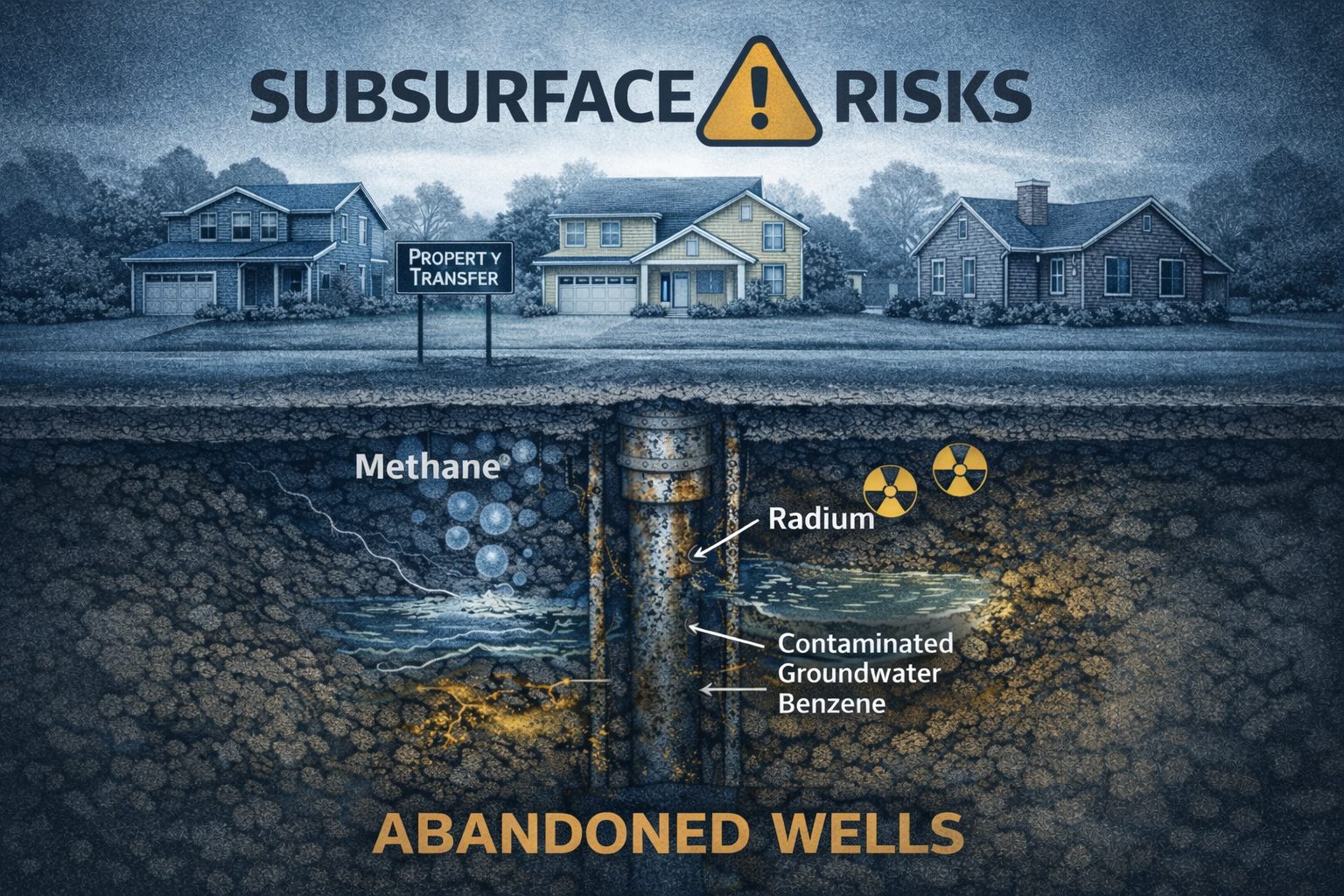
Leakage from legacy oil and gas wells is rarely found through a regulatory inspection program. It's found when someone lives nearby and something ordinary stops adding up. A homeowner notices persistent methane readings during a remodel. A rancher sees unexplained vegetation stress or salt staining near an old well pad. A lender requires groundwater testing during a property transfer, and the results come back inconsistent with baseline expectations. An excavator hits scale or wet soils while digging a trench.
In several Phase II environmental investigations tied to property transactions in Pennsylvania and Ohio, methane was detected not at the mapped well location but within shallow utility corridors tens of meters away. The original wells were either undocumented or believed to have been properly abandoned decades earlier. No routine monitoring had ever been performed. Discovery happened only because unrelated construction or due-diligence activity intersected a migrated pathway.
These findings rarely come out of targeted oversight. They surface during ordinary land use, often decades after regulatory closure, when records are incomplete and baseline conditions were never established. Detection is reactive rather than systematic, which complicates attribution and delays response.
Proximity Is the Trigger, Not Risk Ranking
Legacy wells aren't evenly distributed, and neither is discovery.
Wells drilled before modern permitting regimes often sit beneath homes, farms, schools, roadways, and utility corridors. In many states, surface development followed drilling rather than the other way around. As a result, the odds that a well's failure gets detected depend less on subsurface conditions than on whether human activity intersects a migrated pathway.
Two wells with identical integrity problems can produce very different outcomes. One stays undiscovered because it lies beneath undeveloped land. The other gets detected because it intersects a basement, a water well, or a utility trench. Discovery is opportunity-driven, not risk-ranked.
Multiple national analyses estimate that millions of people live within one mile of a documented abandoned or orphaned well, which raises the likelihood that routine land use intersects legacy infrastructure. That helps explain why many known incidents appear clustered around populated or actively used land, even though similar wells exist elsewhere. The difference isn't failure probability. It's human presence.
Land Use Becomes the Monitoring System
Because formal post-closure monitoring is rare, land use itself becomes the detection mechanism. The activities that most often trigger discovery are residential construction and renovation, agricultural drainage and irrigation work, utility installation and repair, and the real-estate due diligence and lender-required testing tied to land transfer or redevelopment.
None of these activities are designed to monitor abandoned wells. Yet together they account for a substantial share of documented discoveries. That shifts monitoring responsibility from institutions to individuals by default, not by design.
Information Asymmetry at the Moment of Discovery
When landowners run into evidence of leakage, they usually face three constraints at once.
The first is incomplete records. Well locations may be inaccurate, undocumented, or misclassified, and plugging reports, where they exist, may predate modern standards or be hard to obtain. The second is fragmented jurisdiction. Oil and gas regulators, environmental agencies, local authorities, and private consultants all operate within different scopes, and figuring out who has authority often takes more time than the initial investigation. The third is the absence of baseline data. Without pre-existing groundwater, soil, or gas measurements, discovery establishes that something is present but not when it started or what caused it, which makes attribution and liability harder to sort out.
At this stage, landowners aren't acting as plaintiffs or advocates. They're acting as unplanned field investigators.
Cost and Risk Shift Before Liability Is Determined
The initial costs almost always fall on the landowner. Testing, site access, temporary mitigation, consultant fees, and legal review tend to come before any determination of responsibility. Even when regulators ultimately step in, the first steps are usually privately funded.
What matters isn't only that landowners discover these issues, but when they do. Discovery that happens after operator insolvency, asset transfer, or regulatory closure materially changes who bears responsibility. In many cases the timing of discovery, rather than the cause of leakage, decides whether remediation is treated as a private dispute, a state obligation, or a federally funded orphan response. That isn't a legal anomaly. It's a structural outcome of delayed discovery in systems without post-closure monitoring.
Why This Pattern Persists
The system didn't explicitly assign monitoring responsibility to landowners. It assumed monitoring was unnecessary. Plugging was treated as permanent, oversight ended when the paperwork was filed, and financial assurance covered closure rather than decades of uncertainty.
So this isn't a failure of individual regulators or landowners. It's the predictable outcome of a system that treated abandonment as permanent and therefore unmonitorable. Only when degradation, pressure migration, or disturbance reveals a pathway does the assumption fail, and by then the only people positioned to observe it are those living or working nearby.
What Landowners Aren't Equipped to Do
Landowners generally can't distinguish wellbore leakage from off-well migration, determine whether detected methane is thermogenic or biogenic without specialized analysis, identify historical well construction or plugging methods, navigate overlapping regulatory authority efficiently, or absorb extended investigative and remediation costs. Yet current discovery pathways implicitly rely on them to initiate all of it. That mismatch between responsibility and capacity defines much of the abandoned-well problem at ground level.
The Broader Implication
When discovery depends on proximity rather than monitoring, the impacts land unevenly. Communities with higher development density, older housing stock, or active land use are more likely to encounter legacy well issues, not because they face greater subsurface risk, but because they intersect it more often. In effect, landowners function as a decentralized, unpaid detection network, exposing problems that would otherwise stay invisible.
Where This Leaves the System
From an engineering and risk-management standpoint, relying on incidental discovery is both inefficient and inequitable. It delays detection, increases uncertainty, and pushes costs toward the people least equipped to manage them. It also obscures the true scope of the problem by tying visibility to land use rather than to underlying well conditions.
The remaining question isn't whether landowners will keep discovering legacy well failures. They will. The question is whether discovery stays accidental, or whether systems evolve to identify high-risk wells before proximity turns private landowners into first responders.
Next in the series:
Article 9: "When Records Lie: Why Abandoned Well Databases Are Incomplete by Design"
Sources and Further Reading
The sources below support the discovery pathways, proximity dynamics, and post-closure monitoring gaps discussed in this article. They are provided for technical and regulatory context rather than case adjudication.
Proximity and population exposure
U.S. Environmental Protection Agency (2023).
Inventory of U.S. Greenhouse Gas Emissions and Sinks – Abandoned Oil and Gas Wells.
https://www.epa.gov/ghgemissions/inventory-us-greenhouse-gas-emissions-and-sinks
Interstate Oil and Gas Compact Commission (2024).
Supplemental Report on Orphaned and Abandoned Wells.
https://iogcc.ok.gov
Discovery through land use and development
U.S. Government Accountability Office (2019).
BLM Should Address Risks from Insufficient Bonds to Reclaim Wells. GAO-19-615.
https://www.gao.gov/products/gao-19-615
Resources for the Future (2023).
Decommissioning Orphaned and Abandoned Oil and Gas Wells: New Estimates and Cost Drivers.
https://www.rff.org/publications/journal-articles/decommissioning-orphaned-and-abandoned-oil-and-gas-wells-new-estimates-and-cost-drivers/
Post-closure oversight gaps
National Academies of Sciences, Engineering, and Medicine (2024).
Practices and Standards for Plugging Orphaned and Abandoned Hydrocarbon Wells.
https://www.nationalacademies.org/our-work/practices-and-standards-for-plugging-orphaned-and-abandoned-hydrocarbon-wells
Interstate Oil and Gas Compact Commission (2020).
Idle and Orphan Oil and Gas Wells: State and Federal Approaches.
https://iogcc.ok.gov/sites/g/files/gmc836/f/documents/idle_and_orphan_wells_report.pdf
Landowner discovery and regulatory interface
U.S. Environmental Protection Agency (2016).
Hydraulic Fracturing for Oil and Gas: Impacts from the Hydraulic Fracturing Water Cycle on Drinking Water Resources.
https://www.epa.gov/hfstudy
Optional contextual references (property & transactions)
U.S. Environmental Protection Agency.
All Appropriate Inquiries Rule (Phase I Environmental Site Assessments).
https://www.epa.gov/brownfields/all-appropriate-inquiries
American Society for Testing and Materials (ASTM).
ASTM E1527-21 – Standard Practice for Phase I Environmental Site Assessments.
https://www.astm.org/e1527-21.html