
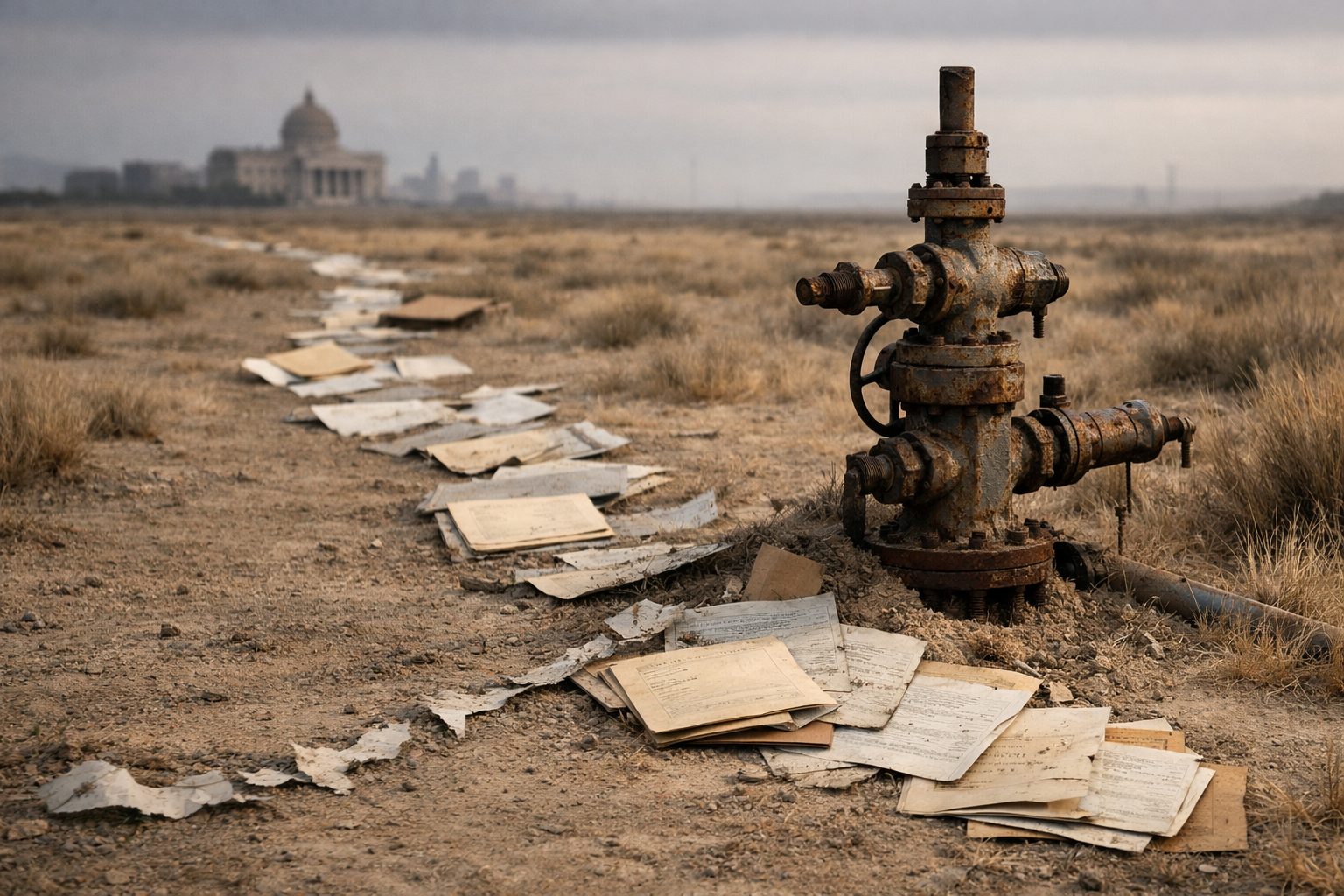
This is Article 16 in an ongoing series examining America's abandoned and orphaned well problem.
A lot of this series has focused on how wells fail over time. Cement breaks down, casing corrodes, records get lost, operators change, and regulators end up with a backlog they were never built to handle. But there's another part of this story that matters just as much, which is what happens when the legal system starts asking whether those liabilities were ever really gone. That question is coming up more often now, and not just in policy debates. It's showing up in court.
For a long time, the working assumption in oil and gas was pretty simple. If a well changed hands, the plugging obligation went with it, and if a company later failed, the cleanup problem moved into the usual mix of bonds, bankruptcy proceedings, state orphan programs, and public money. On paper, that looked workable. In practice, it left plenty of room for liability to disappear into the gap.
A mature well could be sold to a smaller operator, then sold again, then moved into a thinner company with weaker finances. Years later, when the well became a real problem, the company still holding it often didn't have the money to plug it, while the company that benefited most from the productive life of that well was already a few steps removed.
That's the pattern courts are starting to look at more closely, and it matters because the abandoned well problem was never only technical. It was also a problem of timing and accountability. Who had responsibility when the value was being extracted, who had responsibility when the risk was transferred, and who's left when the bill finally comes due?
The old assumption is getting weaker
For decades, the system operated as if end-of-life well obligations could be handled later. They weren't ignored exactly, but they were deferred and pushed down the road, managed through paperwork, bonding, and whatever operator happened to be on the books when the well finally reached the point where something had to be done.
That approach was always shaky, because it depended on too many things going right for too long. The new operator had to stay solvent, the bond had to be enough, the well had to stay quiet, the records had to stay traceable, and the state had to catch problems before they got worse.
What some of the more recent cases are exposing is something even more basic. In some situations, the transfer itself may have been where the system stopped functioning the way it was supposed to. That doesn't mean every sale of aging wells is improper, and most aren't. But some transfers may have leaned on a convenient fiction, which is that the cleanup burden could be handed off even when the buyer wasn't really in a position to carry it. That's where accountability starts coming back into view.
Why this is ending up in court
Courts aren't getting pulled into this because they suddenly care about plugging policy. They're being asked to answer a more practical question. Can a company profit from a well, move the late-life burden into weak hands, and then treat the cleanup as somebody else's problem once the economics turn?
That question tends to show up in two places. One is in transactions, where a seller transfers mature assets to a smaller or more lightly capitalized buyer, and plaintiffs later argue that the deal effectively shifted liabilities the buyer never had the financial strength to absorb. The other is in bankruptcy, where a company fails and the legal system has to decide whether cleanup is a real obligation tied to the asset or just another claim competing with lenders and everyone else.
Those may sound like separate issues, but they're really two versions of the same fight. One asks whether liability was moved in a way that shouldn't have happened, and the other asks whether liability can be pushed aside once the money runs out. Either way, the deeper issue is the same. Are these wells carrying real obligations that stay attached to the economic life of the asset, or are they burdens that can be discounted until the public inherits them?
When a sale doesn't really end the story
Article 9 looked at the growing use of fraudulent transfer theories in this space, and that still feels like one of the more important developments in the series.
The point isn't that every sale of aging wells is suspicious. Mature fields change hands all the time, and larger companies often exit marginal assets that smaller operators think they can manage more efficiently. That's ordinary industry behavior. The problem starts when the economics no longer support the closure burden trailing behind the asset. In those situations, plaintiffs have started arguing that the transfer itself deserves more scrutiny, and not just the sale price or whether the paperwork was complete. The real question is whether there was any honest relationship between the value being transferred and the plugging obligation that came with it, which is a meaningful shift.
It suggests plugging liability may not disappear just because the operator of record changes. If wells were moved into a structure that couldn't realistically carry the closure burden, courts may be more willing to ask whether the transfer was, in substance, a liability dump. That matters beyond any one case. It changes what diligence should mean in late-life asset sales, it raises the stakes for sellers who assumed the problem ended at closing, and it signals that courts may be less willing to treat these obligations as distant hypotheticals when the imbalance was obvious from the start.
Bankruptcy is where the ranking becomes visible
Article 10 asked a direct question: when bankruptcy happens, who pays to plug the wells? That's still one of the clearest ways to understand the legal structure around abandoned wells.
Bankruptcy works as a ranking system more than a fairness system. It decides what gets paid first, what gets pushed down the list, and what gets left with too little support when the money runs out. That's why environmental cleanup can look so different across jurisdictions.
In Canada, the Redwater decision made clear that a receiver couldn't keep the value and walk away from the closure burden, so cleanup stayed attached in a much harder way. In the United States, the framework is narrower and more fragmented. There are limits, but the system still leans heavily on bonding and state backstops when insolvency outruns financial assurance.
That distinction matters because it shows where orphan wells are really being created. It isn't only in the field or in the regulatory file. They're also created in the legal space where cleanup gets pushed behind other claims and turns into an underfunded remainder. When that happens, the cost doesn't disappear. It just moves, to the state, to industry-funded orphan programs, to federal taxpayers, and to landowners who wait while the backlog grows. That's part of what this litigation frontier is bringing into clearer view.
The bigger pattern is hard to miss
What feels different now isn't any single case. It's the pattern you start to see when you put transfers, insolvency, and late-life operations together.
For years, the industry treated the productive value of a well as immediate and the cleanup obligation as distant. One was measured carefully, and the other was managed loosely. That worked, or at least seemed to work, as long as wells kept producing, companies stayed alive, and the real closure bill stayed far enough in the future to ignore. But old wells have a way of collapsing that distance. At some point the value has already been captured, and the obligation is still sitting there.
That's the point the legal system is being pushed to confront. Environmental obligations are getting harder to treat as side notes to the business history of the asset, and they're starting to look more like part of the full economic story. That doesn't mean the law has solved the problem, because it hasn't. But it does mean the old assumption is getting harder to defend. The idea that a trailing obligation can be handed off again and again until nobody serious is left to answer for it isn't holding up as easily as it once did.
What this changes in practice
For operators and buyers, it means late-life wells need a more honest form of diligence. Production decline curves, purchase price, and bond coverage aren't enough on their own. The real question is whether the asset can still carry its own end-of-life burden, or whether the deal only works because that burden is being underpriced.
For lenders and investors, it means plugging liability isn't background noise. It affects valuation, recoverability, and deal quality. An asset package with weak closure economics isn't just operationally risky. It may also become legally unstable if the liability structure gets challenged later.
For regulators, it reinforces something this series has come back to several times. Transfer approvals and financial assurance reviews aren't side issues. They're some of the few moments where future orphan creation can still be interrupted before the cost gets pushed outward.
And for landowners and communities, it helps explain why accountability so often arrives late. The physical problem may be obvious, but the legal responsibility often isn't, and it can take years, sometimes decades, before the chain of transactions and corporate decisions becomes visible enough for anyone to challenge.
What litigation still can't do
It would be easy to overread this trend. Litigation is still a blunt tool, cases are expensive, and they move very slowly. Outcomes depend on facts, timing, and jurisdiction. A lot of wells will never be part of a major lawsuit, and even when a plaintiff wins, that doesn't suddenly create rigs, crews, or immediate cleanup capacity.
In some cases, the courts can help reassign responsibility. They can expose structures that allowed liability to disappear from view and make it harder to pretend a transfer solved a problem when it really just delayed it. But litigation is still a correction after failure. It's not a substitute for a system that prices closure honestly before the failure happens. The fact that courts are being asked to sort this out at all tells you something important about the system we have now. It hasn't been very good at keeping long-tail obligations attached to the value that created them.
The system is starting to catch up
If there's one thread running through this series, it's that abandoned wells rarely become a problem all at once. They become a problem in layers, first in the records, then on the balance sheet, then in the field, then in the budget, and eventually in court. It's in court where something real seems to be shifting.
The law is starting to test whether these liabilities can actually be postponed, transferred, or washed away as easily as the industry once assumed. Not in every case, and not consistently yet, but often enough to matter. That's why this litigation frontier matters, not because courtroom stories are dramatic, but because they suggest the system is starting to pull old liabilities back into view.
For decades, the end of a well's life was often treated as something that could be dealt with later, sold later, or left for someone else. What the courts are beginning to show is that this gets a lot harder to maintain once the value is gone and the burden is all that remains. And that leads to the bigger question. If the legal system is starting to catch up after the fact, what would it take to build a system that makes these obligations harder to evade in the first place? That's where the broader summary of this series needs to go.
Sources and Further Reading
The sources below support the bankruptcy, transfer-liability, financial assurance, and regulatory-context points discussed in this article. They are provided for general legal and policy context, not as legal advice, and to help readers trace the primary references directly.
Core bankruptcy and environmental obligation decisions
U.S. Supreme Court (1985).
Ohio v. Kovacs, 469 U.S. 274.
https://supreme.justia.com/cases/federal/us/469/274/
U.S. Supreme Court (1986).
Midlantic National Bank v. New Jersey Department of Environmental Protection, 474 U.S. 494.
https://supreme.justia.com/cases/federal/us/474/494/
Canadian comparator
Supreme Court of Canada (2019).
Orphan Well Association v. Grant Thornton Ltd., 2019 SCC 5.
https://www.scc-csc.ca/judgments-jugements/cb/2019/37627/
Financial assurance and orphan-well risk
U.S. Government Accountability Office (2019).
Oil and Gas: Bureau of Land Management Should Address Risks from Insufficient Bonds to Reclaim Wells (GAO-19-615).
https://www.gao.gov/products/gao-19-615
U.S. Bureau of Land Management (2024).
Oil and Gas Leasing and Development; Resource Management; Financial Assurance rule and supporting materials.
https://www.blm.gov
Transaction accountability and late-life liability transfer
ClientEarth (2024).
Colorado landowners' lawsuit materials concerning alleged fraudulent transfer of late-life wells.
https://www.clientearth.org
Financial Times (2024).
US landowners sue to force oil company clean-up of abandoned wells.
https://www.ft.com/content/00af1e5f-4120-4630-9053-d09296ad8d22
The Guardian (2024).
Colorado landowners sue oil company over clean-up of orphaned well.
https://www.theguardian.com/us-news/2024/feb/29/colorado-oil-company-sued-clean-up-fraud
Broader orphan-well policy context
U.S. Department of the Interior (n.d.).
Orphaned Wells Program Office.
https://www.doi.gov/orphanedwells
Interstate Oil and Gas Compact Commission (2021).
Idle and Orphan Oil and Gas Wells: State and Provincial Regulatory Strategies.
https://iogcc.ok.gov
Resources for the Future (2021).
Decommissioning orphaned and abandoned oil and gas wells: New estimates and cost drivers.
https://www.rff.org