
This is Article 15 in an ongoing series examining America's abandoned and orphaned well problem.
Most of this series has focused on the costs that come after wells stop producing: plugging them, monitoring them, and dealing with the environmental damage when nobody is left responsible for the cleanup. Those costs are large. The United States alone may have hundreds of thousands of wells that will eventually need to be plugged, and federal and state governments have already committed billions of dollars to start addressing the backlog.
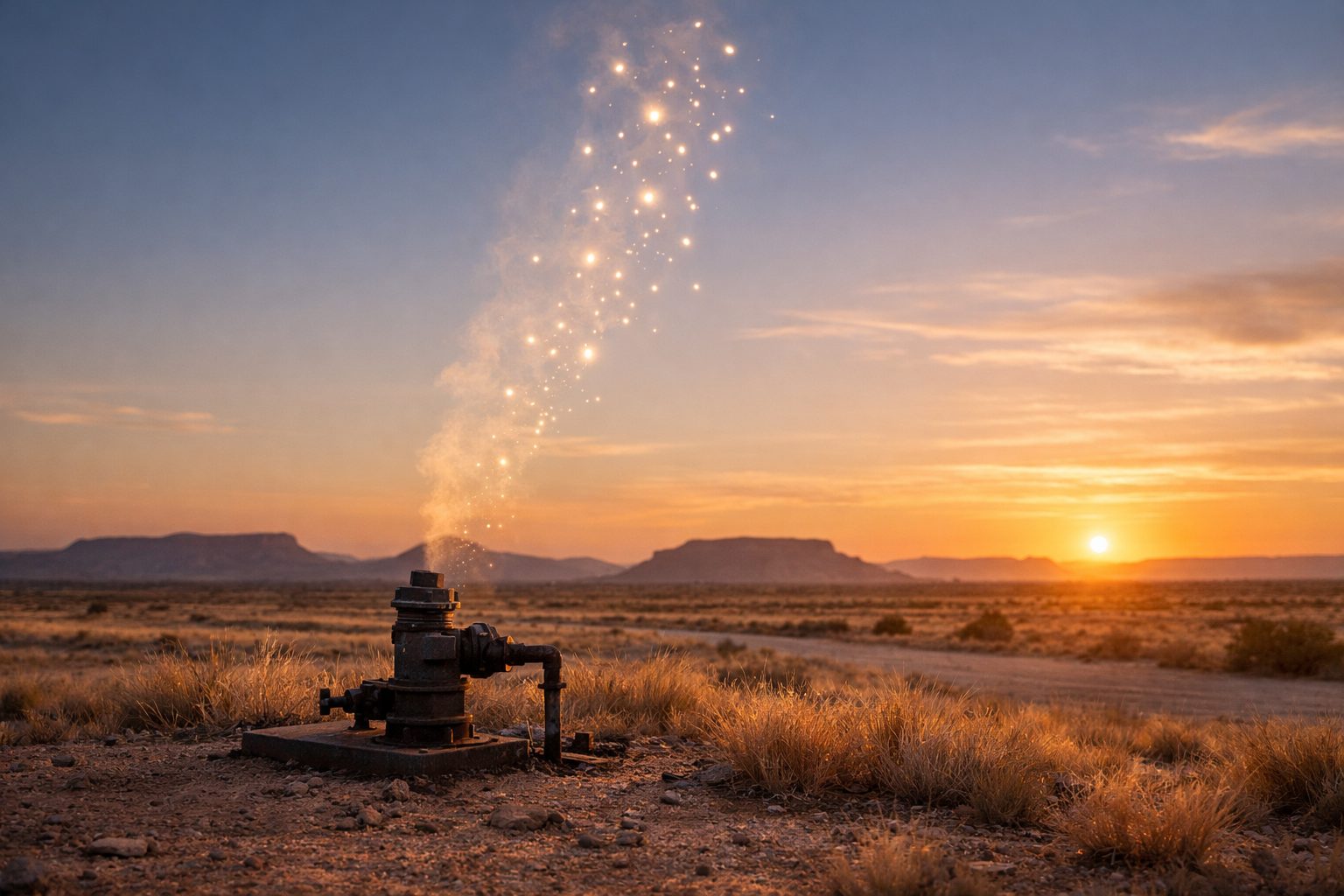
Another question has started to appear in climate policy discussions. Could methane emissions from abandoned wells help pay for their own cleanup? If the emissions can be measured and verified, the reductions created by plugging a leaking well could theoretically generate carbon credits, and those credits could then be sold in carbon markets to help finance the plugging work itself.
At first glance the idea seems straightforward. Stop methane from escaping into the atmosphere and the climate benefit becomes a tradable asset. In practice the details are far more complicated.
Why methane from abandoned wells attracts attention
Methane is one of the most powerful greenhouse gases in the atmosphere. Over a twenty-year period it traps roughly eighty times more heat than carbon dioxide.
Oil and gas wells can leak methane long after production stops. Some leaks are small and barely detectable, while others persist for decades. What makes abandoned wells particularly interesting from a climate perspective is how uneven the emissions are. Measurements across oil and gas infrastructure consistently show a heavy-tailed pattern, where a small fraction of sources produce most of the methane, and abandoned wells appear to follow the same pattern.
Some studies have found that the highest-emitting ten percent of wells can account for more than ninety percent of measured emissions. That means plugging a relatively small number of high-emitting wells could capture a large share of the climate benefit, which is part of what attracted interest from the carbon market. If the worst emitters can be identified, the climate impact of plugging them could be significant.
The funding problem carbon markets are trying to solve
The financial side of abandoned wells is difficult. Plugging and restoring a well typically costs tens of thousands of dollars and sometimes much more, and older wells with poor records or damaged casing can cost far more to remediate. Multiply that by hundreds of thousands of wells and the national liability grows quickly into the tens of billions.
The federal government took a major step toward addressing the problem through the Infrastructure Investment and Jobs Act, which allocated $4.7 billion to orphan well cleanup programs. That funding is already supporting large state and federal plugging efforts, but even that level of funding only begins to address the total backlog.
This is where the carbon credit idea entered the conversation. If methane reductions from plugging wells could generate tradable credits, private capital might help finance some of the cleanup work, and in theory the climate market could help close part of the funding gap.
The additionality problem
Carbon markets operate under a basic principle called additionality. A carbon credit should only exist if the emissions reduction would not have happened without the revenue from the credit. That becomes complicated when public funding is already paying for the work.
If a state plans to plug a well using federal funding, claiming carbon credits for that same activity raises a question about whether the emissions reduction would have happened anyway. Because of that rule, most carbon registries don't allow projects funded by government cleanup programs to generate credits. The Infrastructure Investment and Jobs Act doesn't explicitly prohibit carbon credit generation, but the additionality requirements used by carbon registries create a practical barrier. As a result, most proposed carbon credit projects focus on wells that aren't already scheduled for government plugging programs.
The first carbon credit methodologies
Two carbon registries have developed methodologies specifically for abandoned well methane projects.
The American Carbon Registry was one of the first to publish a framework for generating credits from plugging orphaned wells. The methodology attempts to estimate how much methane a leaking well would emit over time if it remained unplugged, then compares that projected baseline to the emissions after the well is plugged. The difference becomes the carbon credit. The approach allows credits to be issued for avoided future emissions rather than only the methane measured before plugging, and supporters argue this reflects the long-term climate benefit of eliminating a leak that might otherwise continue for decades. Critics have raised concerns about the assumptions used to estimate those future emissions, because when the baseline is modeled rather than directly measured, the resulting credit volumes can vary widely depending on the assumptions used.
Another registry, BCarbon, developed a different methodology that uses a decline curve approach to estimate future emissions, with the goal of creating a more conservative estimate of how methane leaks change over time. Both systems are still evolving. The number of completed projects remains small, and the methodologies continue to be debated.
How large the opportunity might be
If carbon markets eventually support abandoned well projects at scale, the financial implications could be meaningful. Methane reductions are converted to carbon dioxide equivalents using standard climate accounting methods, and those reductions can then be sold as credits in voluntary carbon markets.
Prices vary widely depending on the perceived quality of the credit. Some voluntary credits sell for only a few dollars per ton, while higher-quality methane reduction credits can trade for significantly more. Under certain assumptions, plugging a high-emitting well could generate enough credits to cover a meaningful portion of the plugging cost. But the economics depend heavily on how emissions are measured and how the credit methodologies are structured, and the number of wells that produce large methane emissions remains uncertain.
The measurement challenge
One of the biggest challenges facing abandoned well carbon projects is measurement. Methane emissions from wells can fluctuate over time. Some wells leak continuously, while others release gas intermittently as pressure conditions change underground, so a well that appears quiet during a short measurement period might still leak later. Accurate monitoring therefore requires careful measurement protocols and sometimes repeated testing.
This uncertainty is one reason the carbon market debate has become intense. If the emissions baseline is wrong, the number of credits issued could also be wrong, and once credits are sold, the climate claim attached to them becomes part of the carbon accounting system.
A possible role, but not a complete solution
Carbon markets are unlikely to solve the abandoned well problem on their own. Most wells probably don't emit enough methane to generate large numbers of credits, and many will still require traditional public funding or operator responsibility to cover the cleanup cost.
But carbon finance could play a role in certain cases. High-emitting wells, particularly those located outside government cleanup programs, may present an opportunity for private capital to fund remediation. If the measurement and accounting frameworks hold up, those projects could capture meaningful methane reductions while helping reduce the overall cleanup backlog.
The bigger question
The abandoned well problem is ultimately about responsibility. For more than a century the benefits of oil and gas production were captured during the productive life of the well, while the environmental liabilities often appear decades later.
Carbon markets introduce a different possibility. They create a financial value for reducing methane emissions today, even if the well itself stopped producing long ago. Whether that mechanism becomes a significant part of the solution is still an open question. The climate market is still evolving, the regulatory frameworks are still developing, and the science of measuring methane emissions from abandoned wells continues to improve.
But the underlying idea is simple. If methane reductions have value, some portion of the cleanup might eventually pay for itself.
Sources and Further Reading
The sources below support the discussion of methane emissions from abandoned wells, carbon credit methodologies, and federal funding programs referenced in this article.
American Carbon Registry (2023).
Methodology for Plugging Orphaned Oil and Gas Wells.
https://americancarbonregistry.org/how-it-works/methodologies
BCarbon (2025).
Oil and Gas Well Plugging and Methane Abatement Methodology.
https://bcarbon.org
Environmental Protection Agency (2024).
Greenhouse Gas Reporting Program – Petroleum and Natural Gas Systems.
https://www.epa.gov/ghgreporting
Interstate Oil and Gas Compact Commission (2021).
Idle and Orphan Oil and Gas Wells: State and Provincial Regulatory Strategies.
https://iogcc.ok.gov
Kang, M., et al. (2014).
Direct measurements of methane emissions from abandoned oil and gas wells in Pennsylvania.
Proceedings of the National Academy of Sciences.
https://www.pnas.org
Resources for the Future (2023).
The Employment Effects of Plugging Abandoned Oil and Gas Wells.
https://www.rff.org
U.S. Department of Energy (2022).
Infrastructure Investment and Jobs Act: Orphaned Well Program.
https://www.energy.gov
U.S. Department of the Interior (2024).
Orphaned Wells Program Office.
https://www.doi.gov/orphanedwells
Zefiro Methane Corp. (2024).
Abandoned Well Methane Abatement Projects.
https://www.zefiromethane.com