
This is Article 11 in an ongoing series examining America's abandoned and orphaned well problem.
In Articles 4 and 5, I looked at why old wells fail quietly and why the financial assurance system often doesn't keep up. This article is the "so what" for taxpayers, landowners, and state agencies.
The U.S. has a growing inventory of orphaned and abandoned wells. Many are harmless. Some leak methane, some leak brine or hydrocarbons, and a smaller number turn into expensive emergencies. The frustrating part is that the problem grows slowly, but the consequences don't arrive on a smooth curve. They show up in bursts.
That raises the core question. Is today's funding approach a one-time cleanup, or the start of a long-term infrastructure program?
The Money Helps, but It Doesn't Solve the Underlying Problem
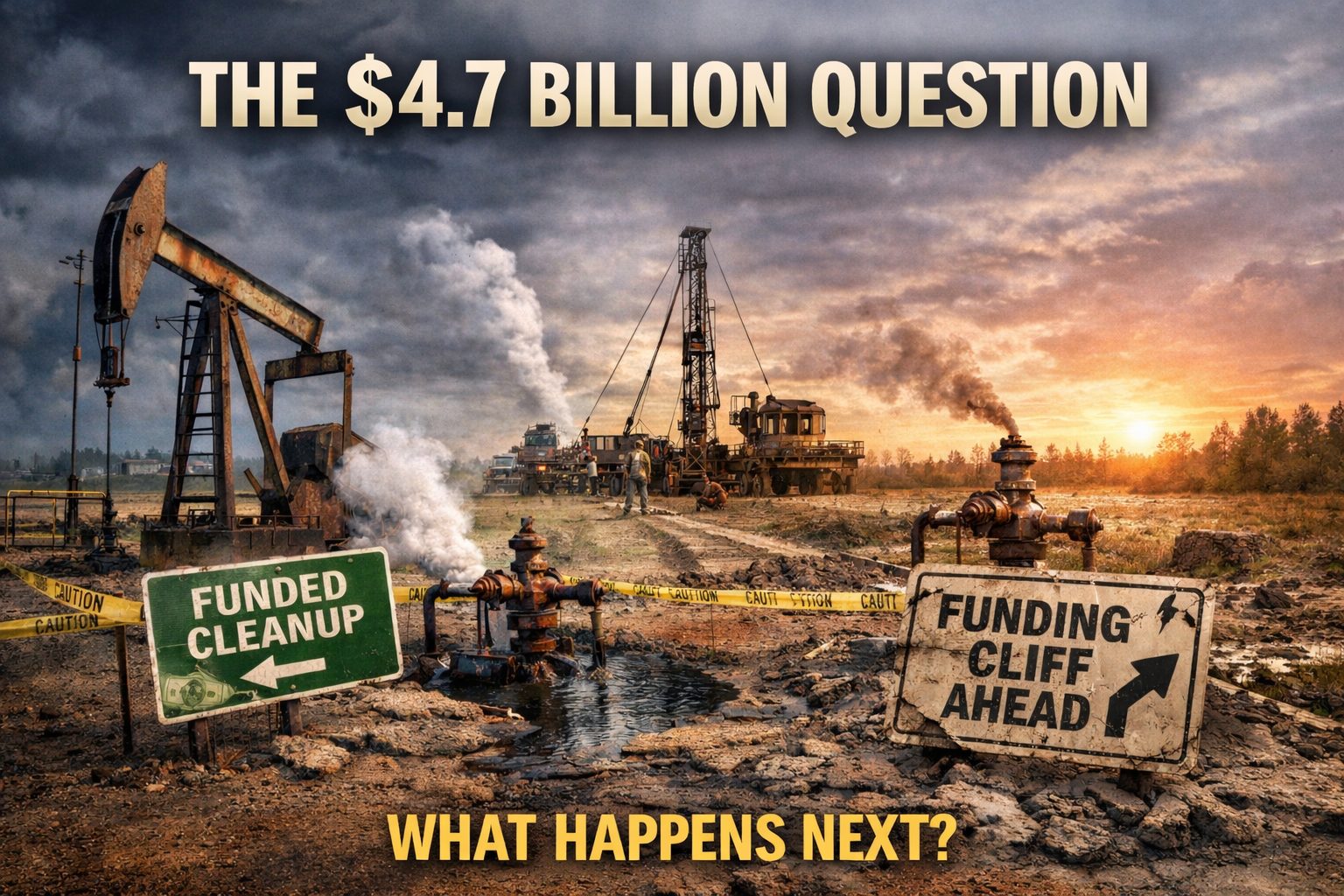
The Infrastructure Investment and Jobs Act (IIJA) set aside $4.7 billion for orphaned well plugging, remediation, and restoration across state, tribal, and federal programs.
That's real money, and it's also easy to misread. A big appropriation can make it feel like we can clear the backlog and be done. I don't think that's the safe assumption.
It's better to treat the $4.7 billion as bridge funding. It can speed up plugging and help states catch up, but it doesn't guarantee the inventory stops growing. If new orphans keep getting added, you're not finishing a cleanup. You're starting a long-running program.
The Math and the Real-World Bottlenecks
Plugging costs vary a lot. Well depth, location, access, condition, and the amount of surface work afterward can all swing the price.
A national study of about 19,500 wells found median costs around $20,000 for plugging only, and around $76,000 for plugging plus surface reclamation. It also found a long tail, where some wells cost far more and rare cases can exceed $1 million.
Even if you take the median, the math gets uncomfortable fast once you apply it to large inventories. That's why I keep coming back to the infrastructure framing. These aren't one-time problems. They're long-duration risks with costs that show up over decades.
Even when funding exists, speed is limited by basic throughput. Contracting capacity isn't infinite. States compete for the same rigs, crews, cement, casing, and experienced field personnel, so when everyone ramps at once, prices rise and schedules slip.
Then there's the inventory work. Records are often incomplete, and some wells are still missing entirely. Even when you find a well, the ownership history can be messy enough that figuring out who's responsible takes real time. In practice, locating, verifying, and prioritizing wells can be nearly as hard as plugging them.
Federal funding also comes with rules, reporting, and oversight. Some of that is necessary, but it can still slow down work that already needs to move quickly. In July 2025, the Department of the Interior revised state grant guidance to speed things up. The revision removed some non-statutory requirements, including pre- and post-plugging methane measurements, and it removed certain post-award environmental review steps not required by statute. The change was explicitly framed as a way to help states move faster.
Texas Shows What "Keeping Pace" Looks Like
Texas is a useful stress test because the inventories are large and the program is mature.
By the end of 2025, Texas reported 11,123 orphaned wells, a roughly 20-year high. At the same time, Texas has been plugging more than a thousand wells per year for years. A state can be working hard and still see the orphan count climb.
Texas also shows what Plan B funding looks like. In June 2025, the Texas Legislature appropriated an additional $100 million for the Railroad Commission's well plugging program, on top of federal dollars. That's the signal worth watching. Even with federal help, states are already preparing to supplement the money just to keep pace.
What Happens After the IIJA Window Closes
The IIJA programs won't last forever. Federal dollars get obligated and spent down, and even when money is technically "available until expended," grants and contracts still run on a timeline in the real world.
If the inventory keeps growing, then once the first wave of funding is gone, states fall back on the usual mix of modest fees, general revenue, and occasional emergency appropriations. The alternative is to fall back on hope, hope that operators will plug wells at end-of-life before those wells become orphans.
That's the real risk. If a system relies on operators doing the right thing, it's vulnerable to the same pattern that built today's backlog: bankruptcies, dissolutions, asset transfers, and years of inactivity that end with nobody left standing behind the liability.
The Takeaway and a Few Questions
The orphan-well problem isn't only a cleanup backlog. It's a recurring liability stream. So the real question isn't how to spend $4.7 billion efficiently. It's how to build a durable system so tomorrow's wells don't become the next orphan inventory.
If you work in this space, I'd value your perspective. Regulators, what's the biggest bottleneck right now, whether it's capacity, inventory work, compliance, or something else? Operators and service companies, what would actually increase end-of-life plugging before financial distress shows up? Landowners, how often do you learn about wells only when something goes wrong? And for investors and insurers, where does this liability sit in your models today, if at all?
Sources and Further Reading
The sources below support the funding, cost, and program execution points discussed in this article. They're provided for context and so readers can trace the primary references directly.
Federal funding and program guidance
U.S. Department of the Interior (n.d.).
Orphaned Wells Program (program overview, guidance, reports).
https://www.doi.gov/orphanedwells (U.S. Department of the Interior)
U.S. Department of the Interior (2025, July 17).
Interior Department revises guidelines to speed up plugging of orphaned oil and gas wells.
https://www.doi.gov/pressreleases/interior-department-revises-guidelines-speed-plugging-orphaned-oil-and-gas-wells (U.S. Department of the Interior)
U.S. Department of the Interior (2024).
Orphaned Wells Program FY 2024 annual congressional report (PDF).
https://www.doi.gov/sites/default/files/documents/2024-11/fy-2024-owpo-annual-congressional-reportfinal-publishing.pdf (U.S. Department of the Interior)
Plugging cost evidence (national-scale)
Raimi, D., Krupnick, A., Shah, J.-S., & Thompson, A. (2021).
Decommissioning orphaned and abandoned oil and gas wells: New estimates and cost drivers. Environmental Science & Technology.
https://pubs.acs.org/doi/10.1021/acs.est.1c02234 (ACS Publications)
Resources for the Future (2021, July 21).
New study reveals key factors for estimating costs to plug abandoned oil and gas wells (summary of ES&T results).
https://www.rff.org/news/press-releases/new-study-reveals-key-factors-for-estimating-costs-to-plug-abandoned-oil-and-gas-wells/ (Resources for the Future)
Resources for the Future (2021, July 14).
Decommissioning orphaned and abandoned oil and gas wells: New estimates and cost drivers (RFF journal article page).
https://www.rff.org/publications/journal-articles/decommissioning-orphaned-and-abandoned-oil-and-gas-wells-new-estimates-and-cost-drivers/ (Resources for the Future)
Texas program context and funding
Railroad Commission of Texas (2025, June 23).
Texas Legislature makes historic investments in RRC's mission (includes $100M for well plugging).
https://www.rrc.texas.gov/news/062325-legislative-funding-press-release/ (Railroad Commission of Texas)
Nostrant, R. (2026, January 21).
Orphaned oil and gas wells in Texas broke a 20-year record in December. Here's why. Houston Chronicle.
https://www.houstonchronicle.com/business/energy/article/orphan-wells-texas-oil-record-21307063.php (Houston Chronicle)
n.d.: no date listed on the source page