
This is Article 12 in an ongoing series examining America's abandoned and orphaned well problem.
The previous articles established a pattern. Wells fail over time, bonding doesn't cover the cost, federal funding helps but isn't a permanent solution, and liability often lands on the people who had the least to do with creating it.
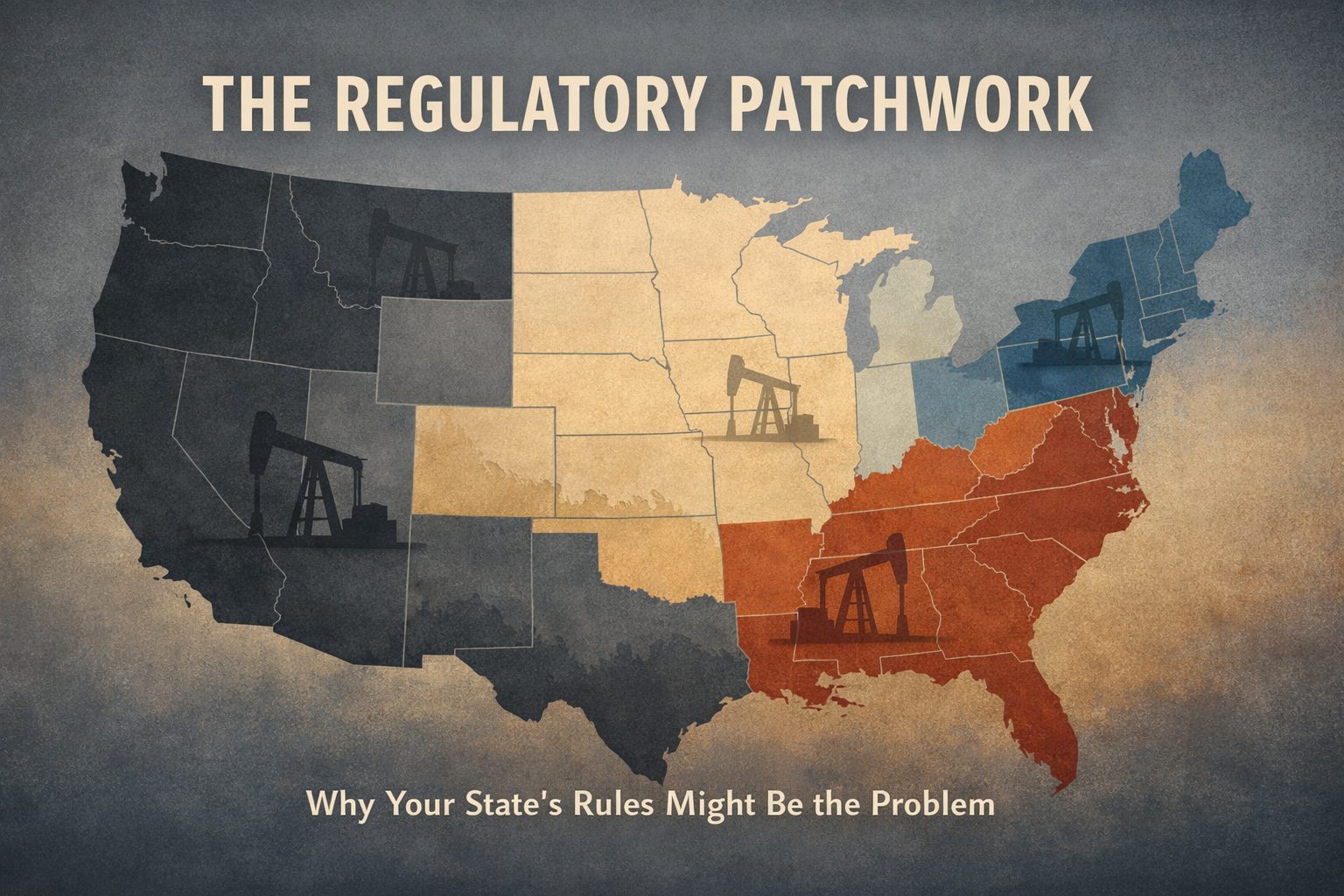
One thing I haven't examined yet is why the outcomes vary so much depending on where the well happens to sit. The answer comes down to regulation, not geology or engineering.
There's no national standard for how states manage end-of-life well obligations. Each state sets its own bonding amounts, its own definition of what counts as an orphan, and its own rules for what happens when operators walk away. Some states have spent the last five years building layered systems to keep pace with the problem. Others have legislatively locked themselves into frameworks that were outdated before the ink dried.
Colorado and Pennsylvania sit at opposite ends of that spectrum. Looking at them side by side tells you a lot about why some states are gaining ground and others aren't.
Colorado: building the system in real time
Colorado has done more in the last four years than most states have done in the last twenty. In June 2022, the legislature created the Orphan Wells Mitigation Enterprise through SB22-198. The bill requires every operator to pay an annual fee on every well that's been spud but not yet plugged. The fee is $125 per well for smaller producers and $225 per well for larger ones, generating roughly $10 million a year in dedicated plugging funds.
In November 2024, the Enterprise Board added a second revenue stream, a $115 per well annual fee on marginal wells, those producing less than 15 barrels of oil or 90 mcf of gas per day. The additional fee is expected to bring in about $5 million a year, and the first round of competitive grants has already funded plugging of 142 marginal wells across 30 operators.
By the end of fiscal year 2025, the program had plugged 95 wells and reduced Colorado's orphan inventory to 948. That's still not a small number, but it's a manageable one. More importantly, the state now has a recurring funding mechanism that doesn't depend entirely on federal grants.
Colorado also overhauled its financial assurance system in 2022. The old framework allowed a $60,000 blanket bond to cover 100 wells, which works out to $600 per well against plugging costs that routinely exceed $100,000. The new tiered system requires the smallest, highest-risk operators to post $110,000 to $140,000 per well in financial assurance. Larger operators with strong track records still pay far less per well, but the floor is substantially higher than what existed before.
It's still not high enough. Carbon Tracker's February 2024 analysis found that Colorado's bonds cover roughly 7% of the state's estimated $7.2 billion in total decommissioning costs. That's a real improvement over the fraction-of-a-percent coverage most states offer, but more than 90% of the liability remains unpriced.
What Colorado didn't pass
Colorado's progress isn't unlimited. In March 2024, the legislature killed SB24-159 on a 5-2 vote in committee. That bill would have phased out new drilling permits by 2030 and, secondarily, would have made former well owners financially liable for orphaned well cleanup through a predecessor liability provision.
It's easy to misread this bill as a predecessor liability reform. In practice, its primary provision was the drilling moratorium, and that's what drew the bipartisan opposition that killed it. The liability piece was a secondary feature that went down with the ship.
Colorado currently has no mechanism to go after prior owners who transferred wells in compliance with the rules that existed at the time of transfer. The state's approach so far has been to build forward-looking revenue systems rather than backward-looking legal claims, and whether that leaves a gap will depend on how many legacy operators' wells end up in the orphan inventory.
Pennsylvania: frozen by design
Pennsylvania is a different story entirely. The state's bonding requirement for conventional oil and gas wells is $2,500 per well, or a $25,000 blanket bond covering all of an operator's wells regardless of how many there are. An operator with 100 wells effectively has $250 per well in financial assurance. Average plugging costs in Pennsylvania range from $33,000 (DEP's estimate) to over $90,000 per well depending on the study. Run those numbers and the gap is obvious. And as we'll see, the state has legislatively tied its own hands.
In 2022, Act 96 became law without Governor Wolf's signature as part of a budget deal. Among other things, it stripped the Environmental Quality Board of authority to adjust conventional well bonding amounts for ten years. That prohibition runs through approximately September 2032, and only the General Assembly can change the bond amounts during that window.
It's worth noting that the EQB was actively considering a petition from environmental groups to raise bonds to $38,000 per well when Act 96 killed the effort.
Then there's the pre-1985 exemption. Wells drilled before April 18, 1985, carry no bonding requirement at all. DEP estimates that a majority of Pennsylvania's 110,000-plus active conventional wells predate that cutoff. According to DEP testimony, 93% of the wells on the state's abandoned inventory were drilled before bonding was required.
Pennsylvania holds roughly $50 million in total bonds against what the state estimates is a $6.6 billion plugging liability for known orphaned and abandoned wells. Carbon Tracker puts the number closer to $15 billion. Either way, the bonds cover less than 1% of the actual cost.
The state's estimated total orphan and abandoned well population ranges from 200,000 to 560,000, with only about 27,000 documented in DEP's database. Pennsylvania has plugged roughly 3,500 wells since 1989. The Shapiro Administration picked up the pace, plugging over 300 wells since January 2023, which is more than the previous eleven years combined. But that sudden increase is driven almost entirely by federal IIJA money.
Reform efforts haven't quit. HB 364, which would restore EQB authority over bonding, passed committee in June 2025 on a 14-12 vote but was laid on the table in September. A coalition led by the Clean Air Council has a constitutional challenge to Act 96 pending in Commonwealth Court (filed August 2023), arguing the bonding cap violates Pennsylvania's Environmental Rights Amendment. That case is ongoing.
The rest of the map isn't much better
Pennsylvania is the most dramatic case of regulatory failure, but it's not alone. Oklahoma maintained a $25,000 blanket bond for unlimited wells until 2025. An operator with 200 wells had effective coverage of $125 per well, and the state's orphan list has grown past 20,000 wells. In May 2025, the governor signed HB 1369, which creates a tiered structure topping out at $150,000 for operators with more than 100 wells. It's a step forward, but $150,000 still doesn't cover the cost of plugging two wells.
Louisiana's story involves a different kind of gap. A 2014 audit found 75% of wells lacked bonding coverage, a number that still gets repeated in policy discussions. But the state actually reformed in 2015 and removed most exemptions. By 2023, roughly 74% of wells had financial security, meaning about 26% still lacked coverage. That's a real improvement over the old number, but the state still has nearly 4,800 orphan wells and plugs only about 125 per year. At that rate, the backlog keeps growing.
Wyoming, on the other hand, has quietly built one of the more functional state systems. Its bonding is set at $10 per foot of well depth, which means a 10,000-foot well carries a $100,000 bond, closer to actual plugging cost than almost any other state. As of mid-2023, Wyoming held $234 million in idle well bonds. In early 2025, the governor signed Senate File 20, creating a $45 million bonding pool to help smaller operators meet rising federal requirements. Rather than just raising the bar and walking away, the state funded a path for smaller operators to get there.
New Mexico is pursuing what might become the most aggressive reform. In late 2025, the Oil Conservation Commission held hearings on proposals that would require $150,000 in bonding per inactive or low-producing well. The state's current median bond value is about $7,000 per well against average cleanup costs of $163,000. The industry is pushing back hard, but the gap between current bonds and actual costs is hard to defend at a public hearing.
The federal floor is shaking
On federal and tribal lands, the Bureau of Land Management finalized a bonding rule in April 2024 that raised individual lease bonds from $10,000 to $150,000 and statewide bonds from $25,000 to $500,000. Those were the first increases since 1960. The prior system averaged roughly $2,100 per well in financial assurance. The rule was supposed to phase in through June 2027, but that timeline is now uncertain.
In February 2025, Interior Secretary Burgum signed an order directing BLM to "suspend, revise, or rescind" the rule. In December 2025, BLM extended the statewide bond compliance deadline by a year. The Independent Petroleum Association of New Mexico stated publicly that the administration plans to formally rescind the rule in 2026.
The rule remains legally in effect and no court has blocked it. But the industry has been advised not to submit increased bonds in anticipation of rescission, and conservation groups have signaled they'll challenge any rollback. If the BLM rule goes away, the patchwork gets wider, because it was the closest thing to a national floor for well bonding.
What actually works
The IOGCC's 2024 survey documented 141,959 orphan wells across 29 states, a 54% increase from 2020. Much of that increase reflects better documentation rather than new orphaning, but either way, the number keeps climbing.
Looking across the states that are actually making progress, a few patterns hold up. Recurring fee-based funding works better than one-time appropriations. Colorado's per-well fees generate predictable revenue that doesn't depend on annual budget fights or federal grant cycles, while states that rely exclusively on bonds and general revenue tend to fall behind. Bonding tied to actual well characteristics also outperforms flat blanket bonds. Wyoming's depth-based bonding and Colorado's tiered system both produce financial assurance amounts that have some relationship to real plugging costs, where Oklahoma's flat $25,000, even after reform, still doesn't.
Two other factors separate the states that are gaining ground from those that aren't. Idle well management catches problems before they become emergencies. California and Texas both impose escalating requirements on wells that sit inactive, because wells that aren't producing and aren't being plugged are the pipeline that creates tomorrow's orphans. Transfer scrutiny prevents the pass-the-trash pattern that Articles 9 and 10 covered in detail. When wells move to smaller, undercapitalized operators without enhanced bonding or review, the odds of those wells ending up orphaned go up sharply.
The core problem
The inconsistency across states isn't just an administrative problem; it's a structural risk factor that shapes outcomes more than most people realize.
A well's long-term fate can depend more on which side of a state line it sits on than on its depth, age, or condition. An operator in Colorado faces tiered bonding, per-well fees, and an active plugging program. An operator in Pennsylvania faces a $2,500 bond, a legislative ban on reform, and a state that can't even count its wells. The gap was designed into the system, and it means the states with the weakest rules are generating the largest future liabilities. The federal funding discussed in Article 11 helps in the short term, but if the underlying regulatory frameworks don't change, the IIJA money is bridge funding to the same place we started.
If you work across multiple states, how do you manage compliance when the rules differ this much? If you're in a state with minimal bonding, what would a workable reform look like that doesn't kill marginal operators?
The next article examines whether the remediation industry has the ability to handle the work even if funding and regulation catch up.
Sources and Further Reading
The sources below support the regulatory, legislative, and financial data discussed in this article. They're provided so readers can trace the primary references directly.
Colorado regulatory framework
Colorado General Assembly (2022). SB22-198: Orphaned Oil and Gas Wells Enterprise. https://leg.colorado.gov/bills/sb22-198
Colorado Energy & Carbon Management Commission (2024, November 22). Orphan Wells Mitigation Enterprise adopts new fee to fund marginal well plugging. https://ecmc.colorado.gov/press-release/orphan-wells-mitigation-enterprise-adopts-new-fee-to-fund-marginal-well-plugging
Colorado Energy & Carbon Management Commission (2025, September 8). State program plugs 95 orphaned wells (FY25 annual report). https://ecmc.colorado.gov/press-release/state-program-plugs-95-orphaned-wells-to-reduce-methane-emissions-and-reclaim-land-in
Carbon Tracker Initiative (2024, February). False Start: Colorado's financial assurance analysis. https://carbontracker.org/standing-at-the-crossroads-colorado-commissioners-facing-difficult-bonding-decisions/
Pennsylvania regulatory framework and litigation
Pennsylvania General Assembly (2022). Act 96: Oil and Gas Well Plugging Oversight, Bonding, Well Plugging Funds. https://law.justia.com/codes/pennsylvania/2022/act-96/
Babst Calland (2022). Bill setting Pennsylvania's conventional oil and gas bonding levels becomes law. https://www.babstcalland.com/news-article/bill-setting-pennsylvanias-conventional-oil-and-gas-bonding-levels-becomes-law/
Commonwealth of Pennsylvania (2025). Shapiro Administration plugs 300th orphaned or abandoned well. https://www.pa.gov/governor/newsroom/2025-press-releases/shapiro-administration-plugs-300th-orphaned-or-abandoned-well
Clean Air Council (2023). Environmental groups sue Pennsylvania's General Assembly over Act 96 bonding cap. https://cleanair.org/well-bonding-suit-pa/
Other state regulatory frameworks
Oklahoma Legislature (2025). HB 1369: Tiered blanket bond structure for oil and gas operators. https://fastdemocracy.com/bill-search/ok/2025-2026/bills/OKB00032147/
Louisiana Legislative Auditor (2024, October). Progress Report: Regulation of Oil and Gas (orphan well financial security analysis). https://app2.lla.state.la.us/publicreports.nsf/0/fd253aa20b74174d86258bbf00730b5c/$file/00006296a.pdf
Wyoming Legislature (2025). Senate File 20: Bonding pool for small operators.
New Mexico Oil Conservation Commission (2025). Case No. 24683: Proposed financial assurance rulemaking.
Federal BLM bonding rule
U.S. Department of the Interior (2024, April 23). BLM final rule: Federal onshore oil and gas leasing (bonding update). 89 FR 30916. https://www.doi.gov/pressreleases/interior-department-finalizes-action-ensure-fair-return-taxpayers-strengthen
Federal Register (2025, December 18). Federal onshore oil and gas statewide bonds: extension of phase-in deadline. 90 FR 59069. https://www.federalregister.gov/documents/2025/12/18/2025-23228/federal-onshore-oil-and-gas-statewide-bonds-extension-of-phase-in-deadline
Independent Petroleum Association of New Mexico (2025, December 19). Trump Administration extends federal bonding deadline; rule to be rescinded. https://ipanm.org/2025/12/19/sec-burgum-trump-administration-extend-federal-bonding-deadline-rule-to-be-rescinded/
National data
Interstate Oil and Gas Compact Commission (2024). Supplemental report: Orphan wells (141,959 wells across 29 states as of December 31, 2023). https://iogcc.ok.gov
Carbon Tracker Initiative (2020). Billion Dollar Orphans: Why millions of oil and gas wells could become wards of the state. https://carbontracker.org/reports/billion-dollar-orphans/
Raimi, D., Krupnick, A., Shah, J.-S., & Thompson, A. (2021). Decommissioning orphaned and abandoned oil and gas wells: New estimates and cost drivers. Environmental Science & Technology. https://pubs.acs.org/doi/10.1021/acs.est.1c02234